The January 2026 Lurid Things
It's about to get...lurid.

Greetings!
Did we survive January? Or did we cling on with all of our fingers, like the holiday lights I still see hung in my neighborhood? In fact, this month’s Lurid Things is dedicated to those who haven’t taken their lights down, as I firmly believe we’re allowed to celebrate something in the bald and barren month of January.
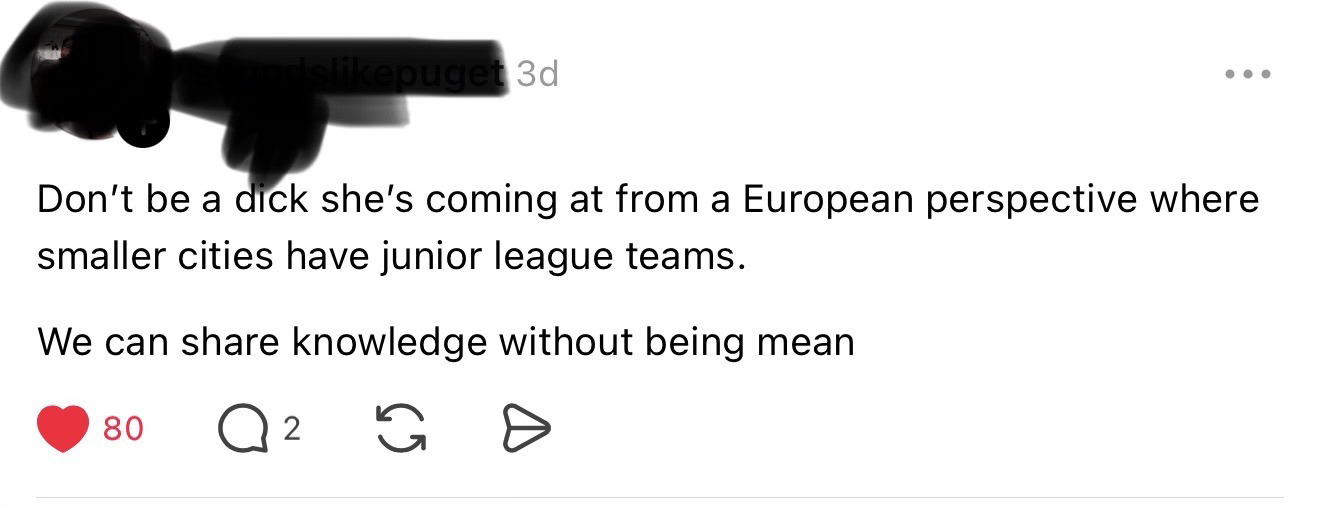
It’s been a dark month for our country, so this month’s Lurid Things is also dedicated to those bright lights that came out of the inter-web woodwork to be the sincere to my silly on Threads this past week:

I also want to give a personal shoutout to those who defended my ignorance only because they thought I was from Ireland:
Without further ado…
Miriam Webster defines ‘lurid’ as:
Lurid: adjective (lu· rid) ˈlu̇r-əd1 a: causing horror or revolutionb: melodramatic, sensational2 a: wan and ghastly pale in appearanceb: of any of several light or medium grayish colors ranging from yellow to orange3 shining with the red glow of fire seen through smoke or clouds
January’s Lurid Things:
(Object) I Fear I May Be Gauche: My Love for Modern “Victorian” Lampshades
(Art) I Repeat: Have You Read Mafia Nanny Yet?!
(Music) “Stay with Me”: The Perceived Tragedy of Miki Matsubara
(Movie) Maybe ‘It Was Just an Accident’: a Review
(Book) Salvage in a Dystopian Future: Tim Chawaga’s Sci-Fi Debut, Salvagia
(Technology) I Spy With My Little Eye: Vivid E-Paper
*This month, we’re down to six essays, skipping ‘sensation’ as I think we’ve already had enough lurid sensations for a bit.
Let’s get lurid.
I Fear I May Be Gauche: My Love for Modern “Victorian” Lampshades
I have two secrets to confess. The first is I have currently in my possession over thirty lamps (the why behind that is a story for another time). Three of said thirty lamps have fringe, and one of the three I would say constitutes a true faux-Victorian lampshade. My second secret is that given the choice, I would trash them all, bases included, not for an actual antique Victorian lamp, but rather, for one of these:
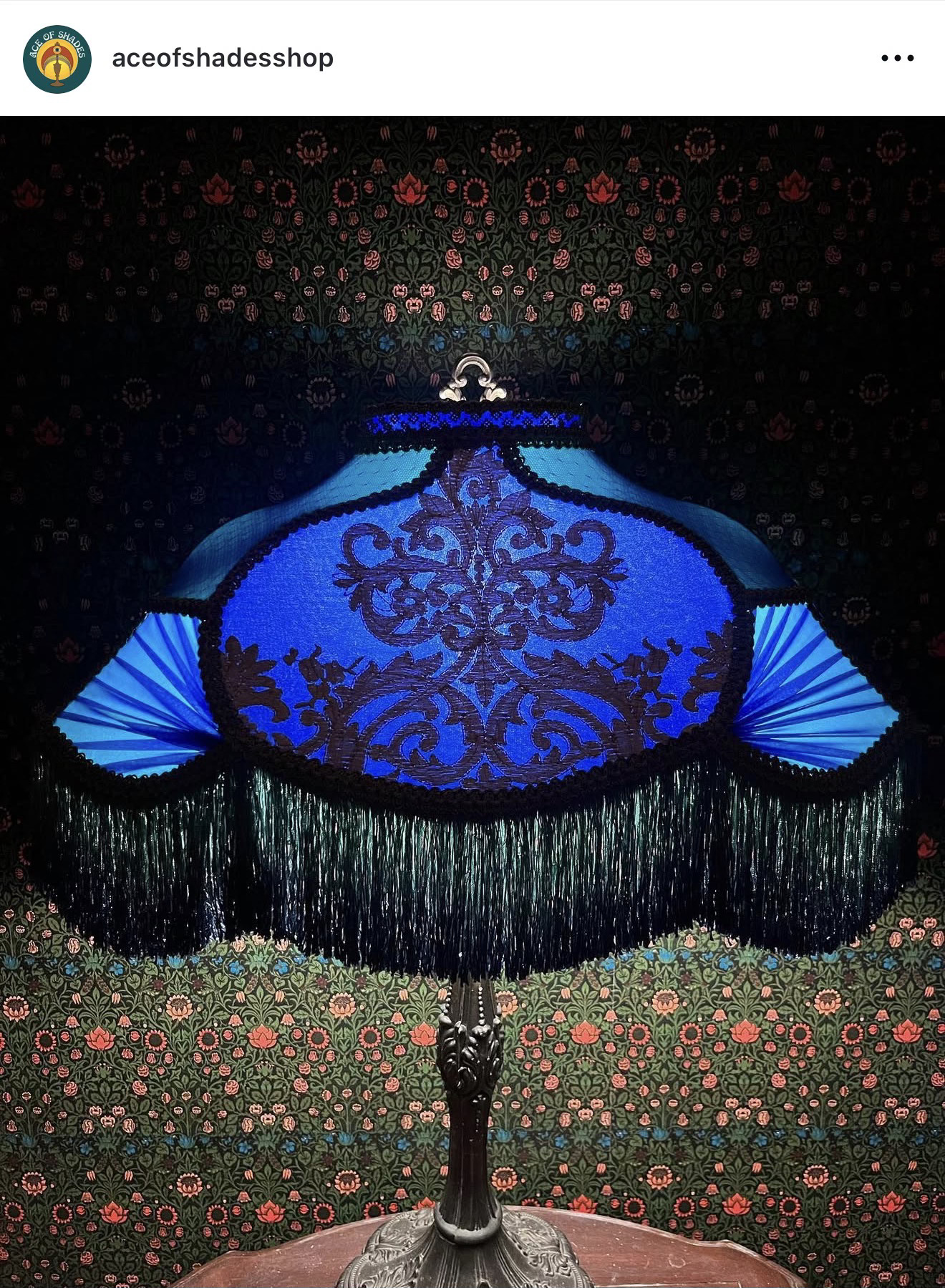
In light of my disclosure to you, it should come as no surprise that when I encountered Ace of Shades’ page on Instagram, I was in Victorian lampshade heaven.
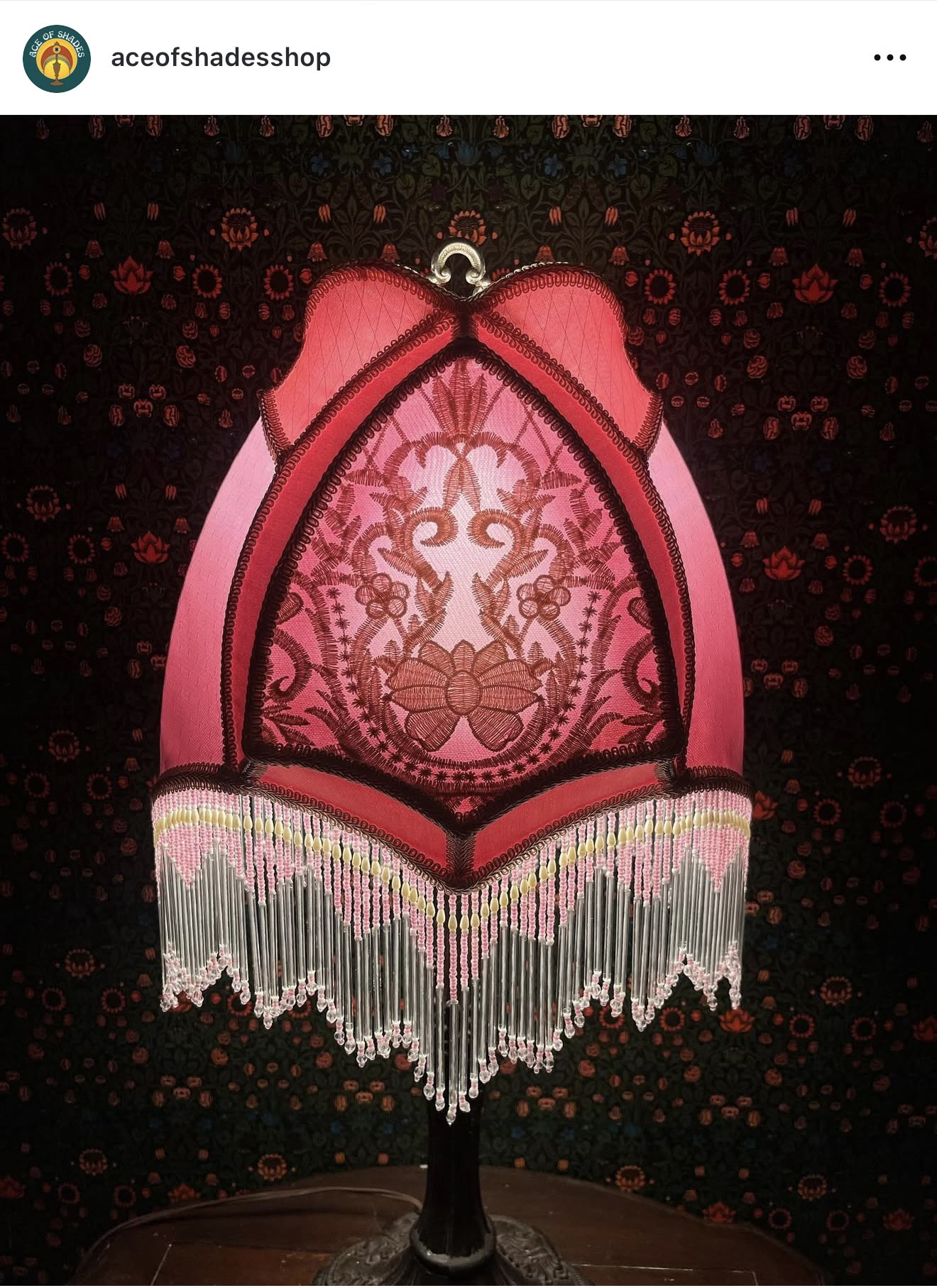
Or so I thought.
Ivy Karlsgodt started her shop,1 Ace of Shades, in 2020 when she lost her Broadway costuming job during the pandemic. Like many of us who stayed inside, Karslgodt looked for ways to update her space and found Victorian lampshades. The one she had her eye on was out of her price range, so she decided to give it a go herself and put her sewing skills to use. She uploaded her final product to TikTok and it quickly went viral. Since then, she’s gone on to create pieces for Fair Lane, the Henry Ford Estate in Dearborn, and even Stevie Nicks has licensed images of her works.
Are Karlsgodt’s creations true Victorian lampshades? Well, not quite.
Encyclopedia Britannica2 classifies the Victorian Era roughly from 1820 to 1914, though Queen Victoria of England ruled from 1837 until her death in 1901. Candles ruled interiors,3 despite the invention of gas and the adoption of it to light London’s street corners. In 1859, Parliament was finally outfitted with gas, and the technology rode an upswing in popularity into the home. It was around this time that glass or silk shades started to become more elaborate, especially after the revival of rococo styles across England and Europe. Silhouettes became romantic, designs became complex, and the lampshade became another way to flaunt your worldliness and wealth in the British Royal Empire.
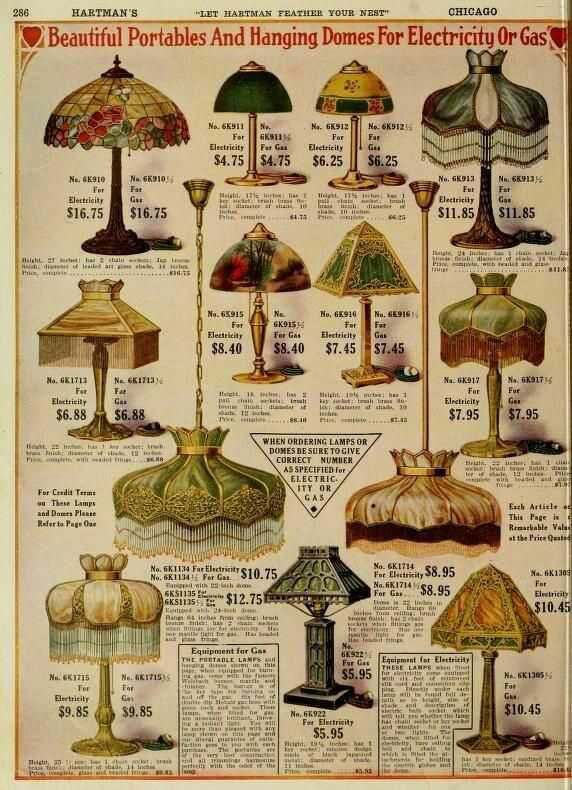
In my quest for historical accuracy for this article, I spent many hours researching antique Victorian silk lampshades. My goal was to find antiques, preferably antiques residing in current museum collections or historic home catalogs. My results were dismal. The reason, I found, lies in the nature of the fabric used during the Victorian era, i.e., silk.

Silk fabric4 is made from the threads spun together with an organic gum called sericin to form a cocoon. By unwinding the fibers of treated cocoons, one can reel the threads into a fiber-bound spool, which can then be dyed and woven into fabric, and then further treated.5 It’s a thousands-of-years-old process, and the end result is a surprisingly durable cloth. Unless, of course, you add constant heat to the fabric, such as is the case with a flame, gas, or an electric, gorgeous-looking lamp.
Even with a liner and a final treatment, silk can begin to degrade at 140°F.6 For comparison, a candle flame is approximately 2,192º F7 and the filament of incandescent light bulbs of the Victorian period reached about 4,600º F8. It’s no wonder that few original Victorian lampshades have survived.
I was able to find a couple historic photographs of Victorian parlour interiors, so here are some examples of period-specific Victorian lampshades (and I love you all, but not enough for those Getty prices9):
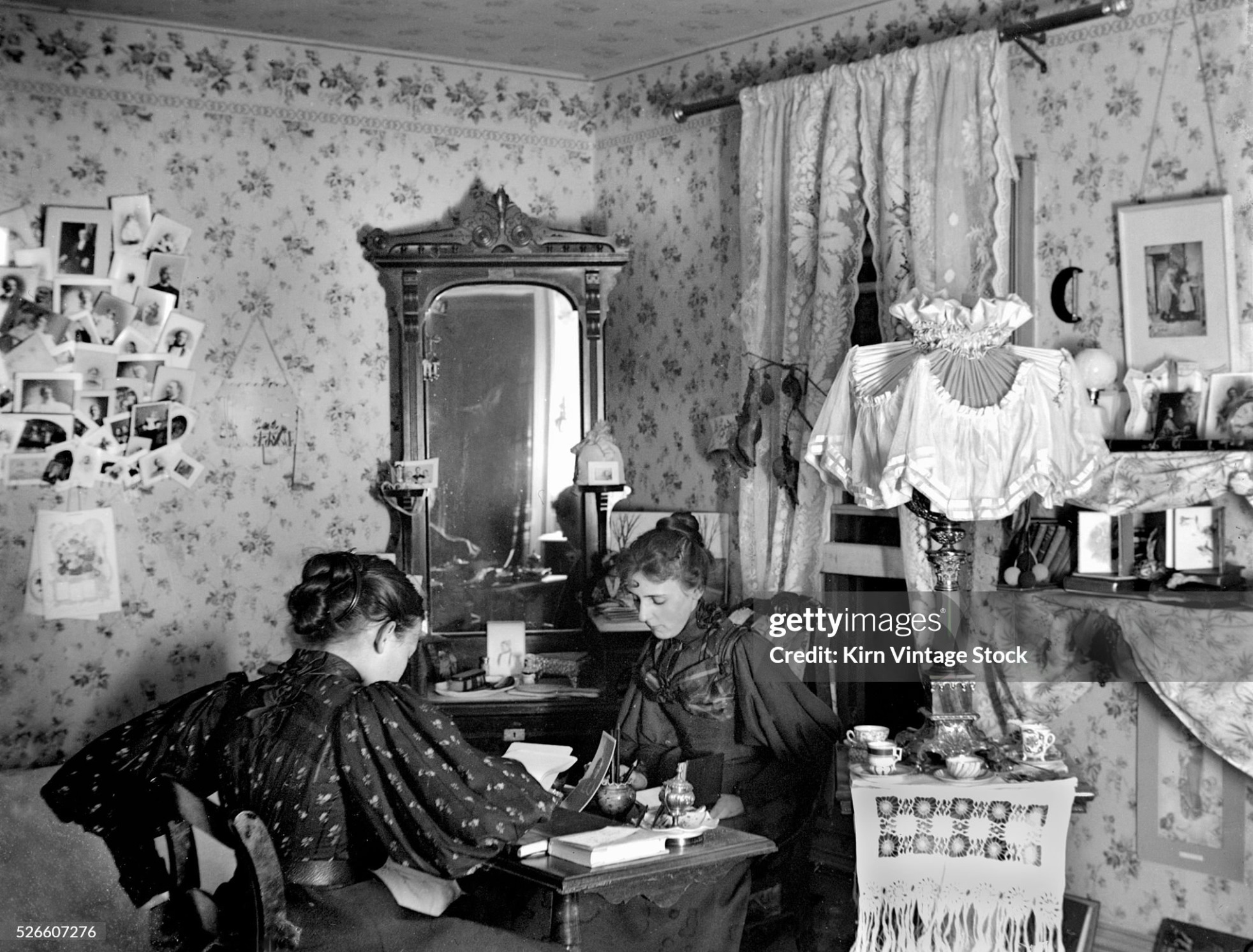
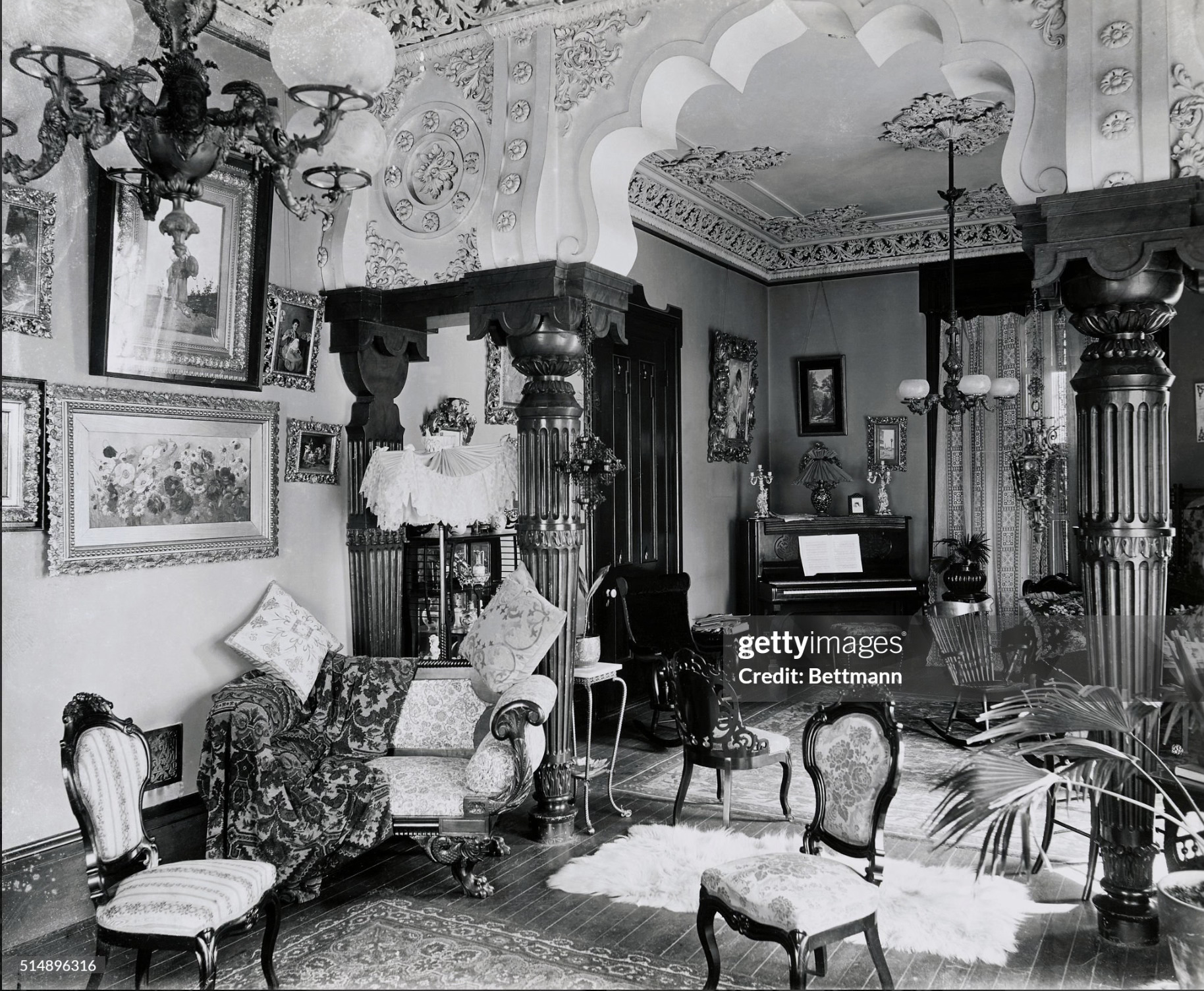
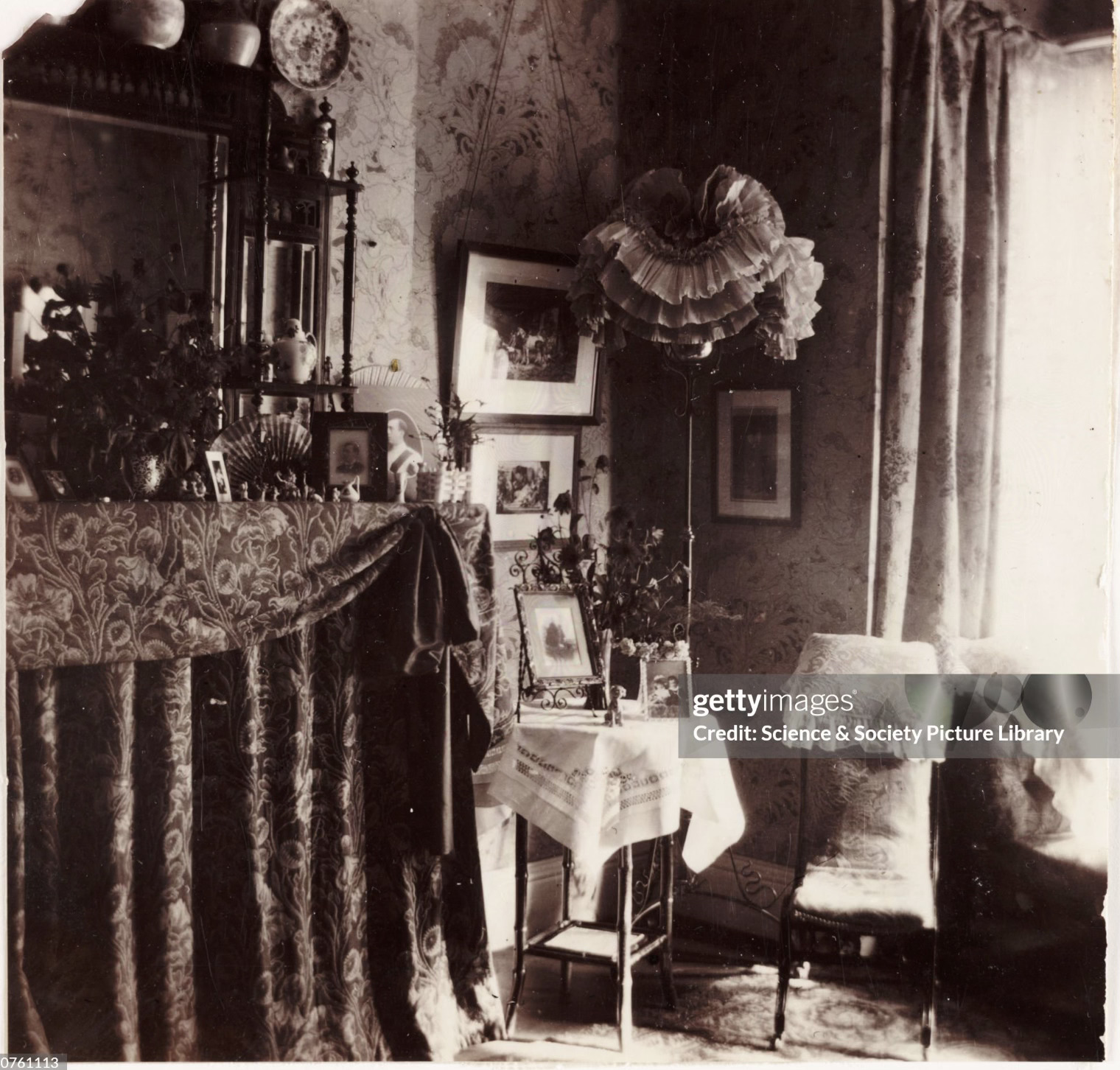
As you can see from the above images, Karlsgodt’s designs aren’t quite the same. They cover a wide swath of ground but primarily fall into more of what we understand to be Art Deco (1920s-30s) than true Victorian. Design historian Marilyn F. Friedman defines Art Deco as:
…an artificial construct, devised by design historians in the late 1960s to refer to works exhibited at the 1925 Exposition internationale des arts décoratifs et industriels modernes in Paris…a period of prosperity marked by the syncopated rhythms of jazz, abstraction and exoticism in art, and a sense of joie de vivre…The simplification of form and the elimination of applied ornament in favor of inlays are but two examples of the ways in which the new style differed from those of the past.10
Karlsgodt’s creations have the characteristics of color vividness, color contrast, sharp angularity,11 and geometric patterning.12
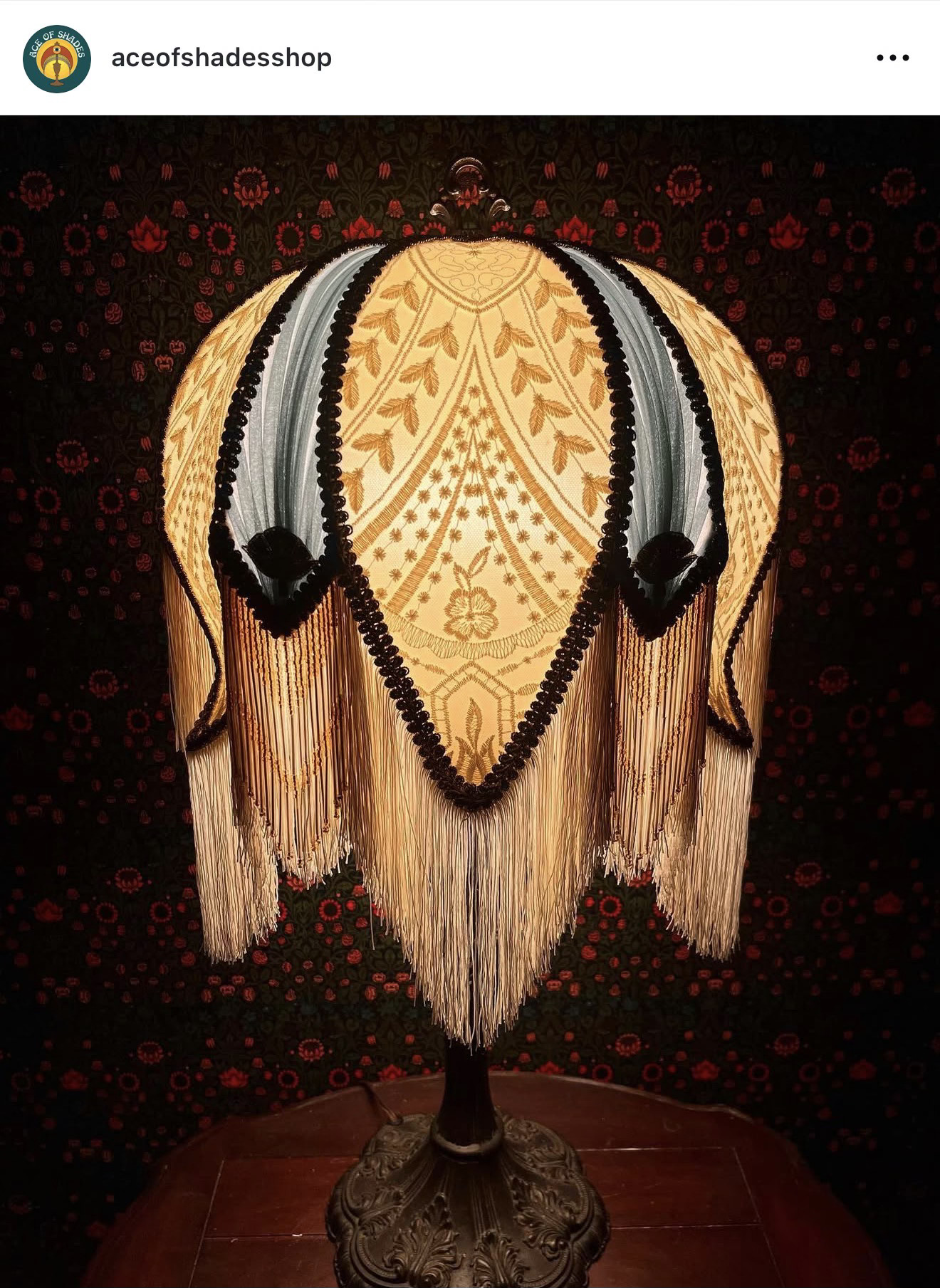
What does it mean that I like her creations (which one could argue are reimaginings of 1920s reimaginings of 1800s creations)? That I like a copy of a copy? How gauche!
Ultimately, I think it means that I like well-crafted, imaginative, and whimsical art. Karlsgodt’s creations are gorgeous, even if they’re not exactly historically accurate. But how would one learn this craft, save enrolling in one of the very few dwindling (and niche)13 craft trade schools? Karlsgodt herself has admitted that the materials in which to learn the craft are sparse: “‘There’s not a lot of resources to learn how to do it,’ said Karlsgodt. ‘There’s those instructional DVDs and there’s probably a book or two out there, but I’ve never read them. I learned a lot from older lampshade makers and that’s how I think a lot of these more niche things are – things are just passed down sort of orally, so I would love to teach.’”14 The DVDs she’s referring to are those of Mary Maxell,15 another self-taught creator.16
At the time of writing, I’m waiting for notification that Ace of Shades’ newest batch of designs are available for purchase online. They do, after all, cost around the price of a Getty image. With designs like this, if you had the money, wouldn’t you spend it?
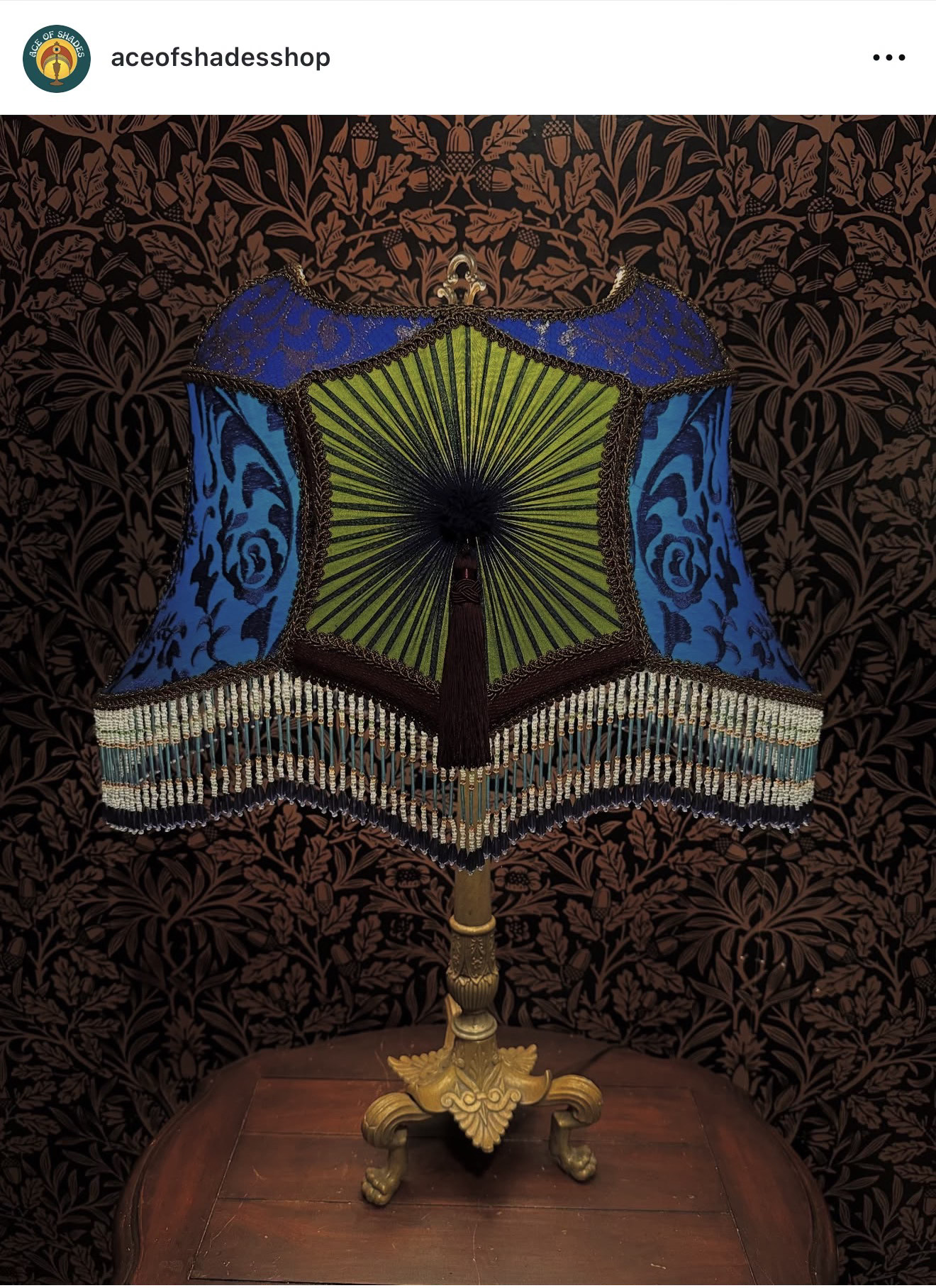
You can check out the Ace of Shades shop here
Some of my other notable Victorian lampshade favorites:
I Repeat: Have You Read Mafia Nanny Yet?!

…Have you?!
I became acquainted with the platform that hosts Mafia Nanny, Webtoons, by route of the Eisner, Harvey, and Ringo Award winner Lore Olympus (Rachel Smythe’s webcomic that was a romantic, swoon-worthy reimagining of the Persephone and Hades myth). Sometime after I finished Lore Olympus (staring at the walls of my house for days? Weeks, maybe?), I stumbled across Violet Matter’s webtoon. When I finally looked up from my screen bleary-eyed (but nonetheless still capable of sight), I’d somehow read all two available seasons.
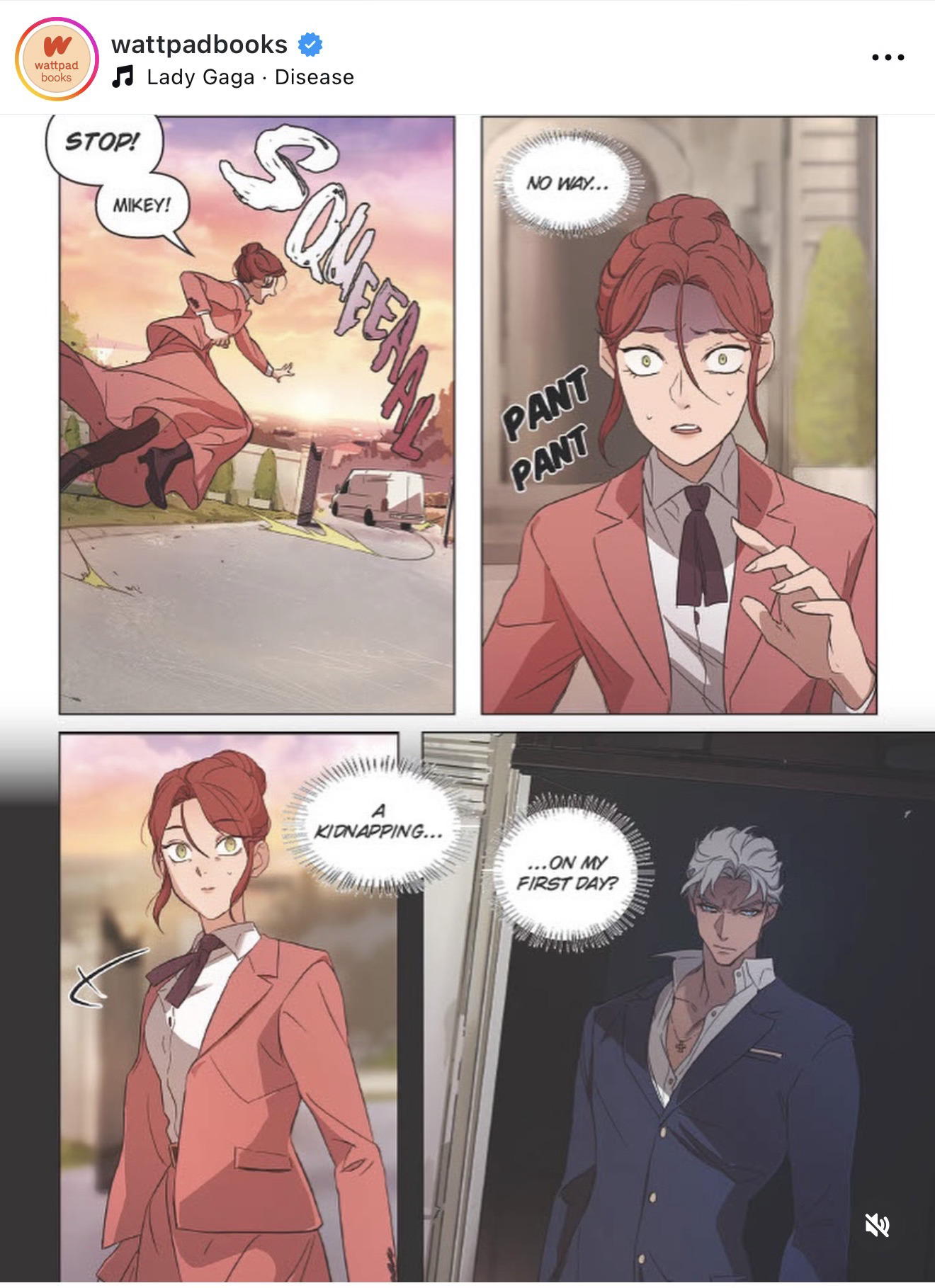
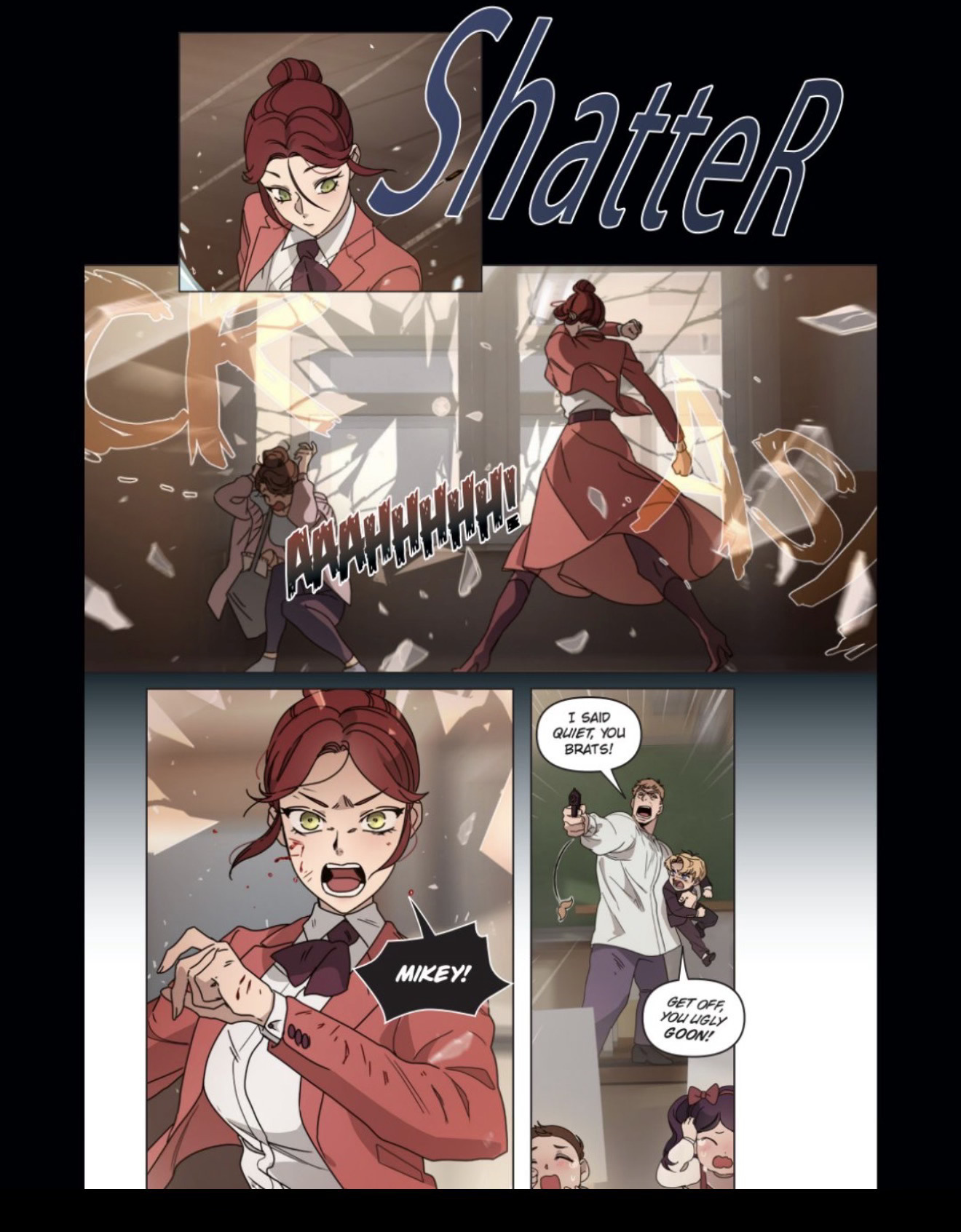
The popularity of Matter’s series is undeniable. At the time of this writing, Mafia Nanny has over 4.2 million subscribers, 278.9 million views, two published books, and a third web installment on the way. It has it all: action, adventure, mystery, a secret nanny spy agency, global mafiosos, humor, and did I mention romance?

Did I gloss over that part? Sorry. It’s technically a romance.
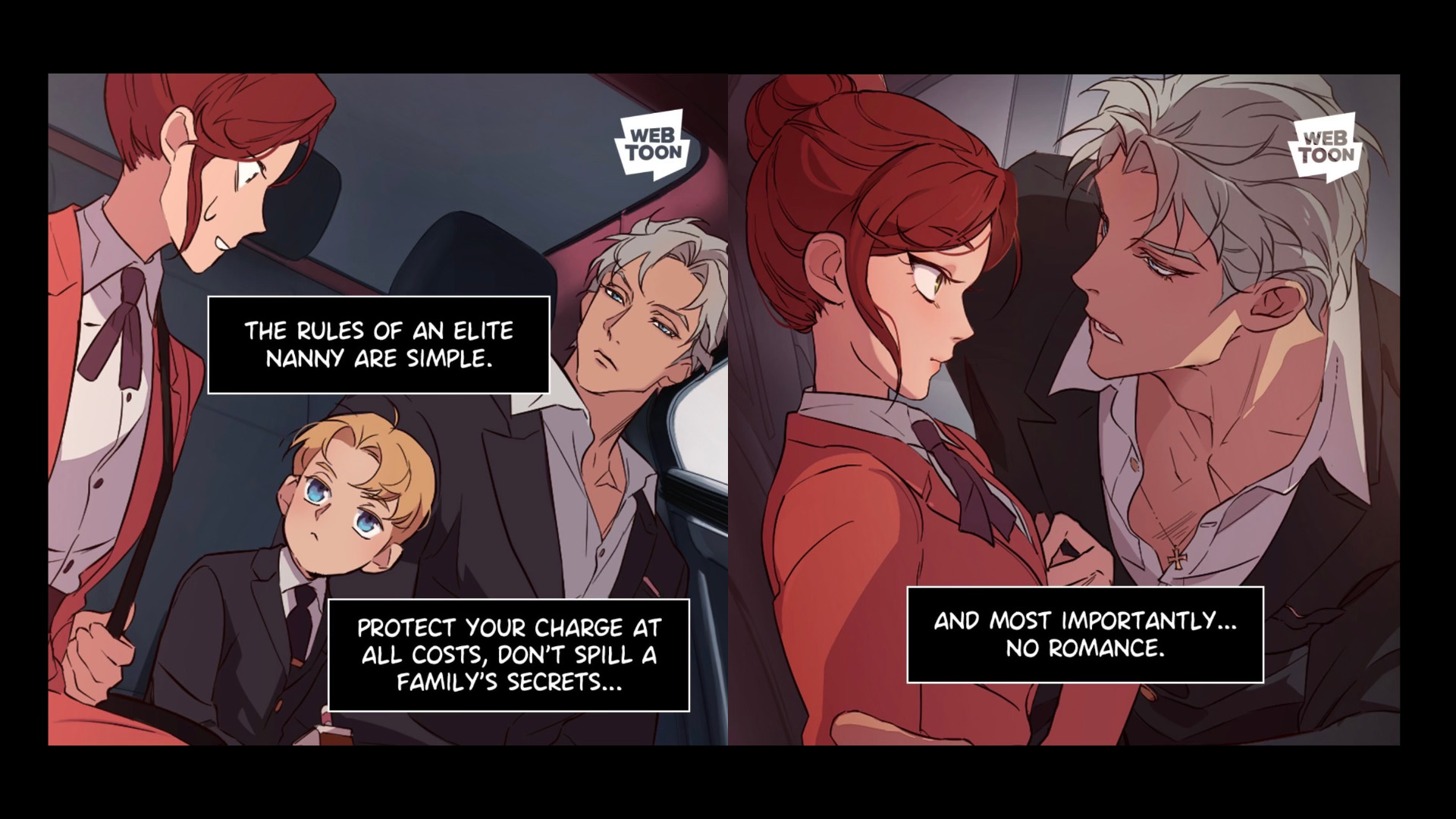
A very gory romance.
On why she wanted to write the series, Violet Matter has said:
I wanted to build on the mafia dynamic because there are a lot of dark stories that already exist within this mafia romance category, but I wanted to shine a new light on this role, because we have a lot of assumptions as a society about nannies. I think there’s an expectation that a certain type of person — young, female, unmarried, possibly unschooled or just out of school — tends to do this type of work.17
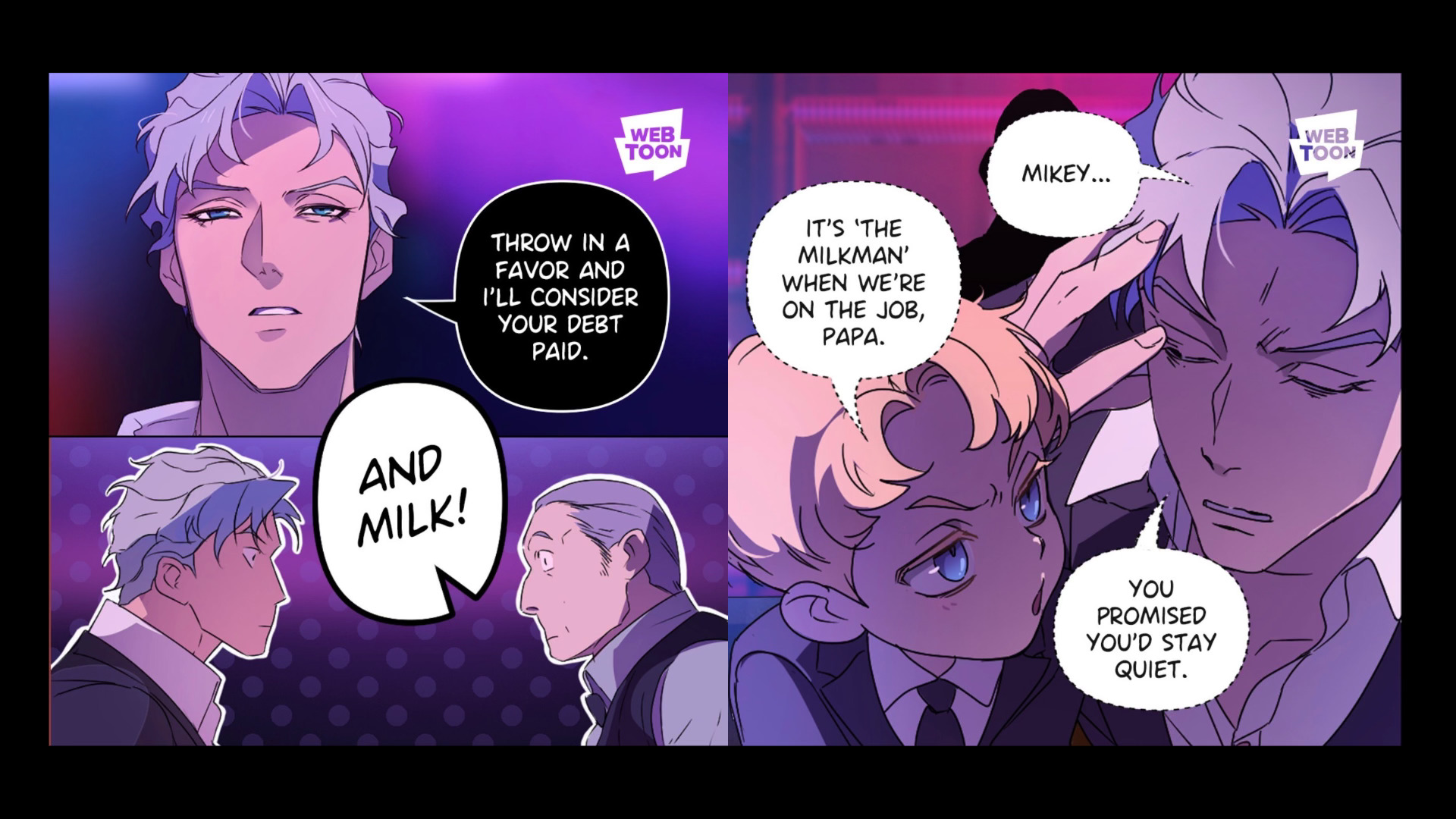
On episode 433 of the What’s Up, Fandom podcast, Matter expressed hope “that the comic ends up conveying…a sincere respect for child care workers around the world.” It succeeds, using down-to-earth, comedic moments with nanny Davina and her charge, Mikey, to offset the mystery, action, drama, and intrigue. On that latter topic, Matter went on in the podcast to discuss how romance wasn’t originally in her wheelhouse, coming off the success of her fantasy Webtoon comic Forever After. Writing a romance series became an opportunity to expand her repertoire, which some might argue is why the series has become such a success: Matter’s lack of experience in the well-trodden genre of dark and angsty mafia romance created an entirely new, fresh take.
What I found most interesting about the series (which I haven’t seen as much as I’d like to) is the depiction of modern crime being mainly online.18 As a fiction writer, I spend a lot of time thinking about world building, and this was, for me, the first compelling action story I’ve read that blended the drama of old school mafia stories with modern technology. Although maybe I’m biased, as I tend to like stories in which organized crime isn’t glorified. Ultimately, I think I’m singing Mafia Nanny’s praises because it made me laugh.
A lot.
Definitely check out the rest of the What’s Up, Fandom episode if you’re interested in learning more about Matter’s background and process, or Webtoons and how they develop their in-house comics. The development track reminded me a lot of old-school Disney, Pixar, Studio Ghibli, and modern-day Cartoon Saloon.
So if you’re looking for a fun series to pick up—

—have you considered reading Mafia Nanny?
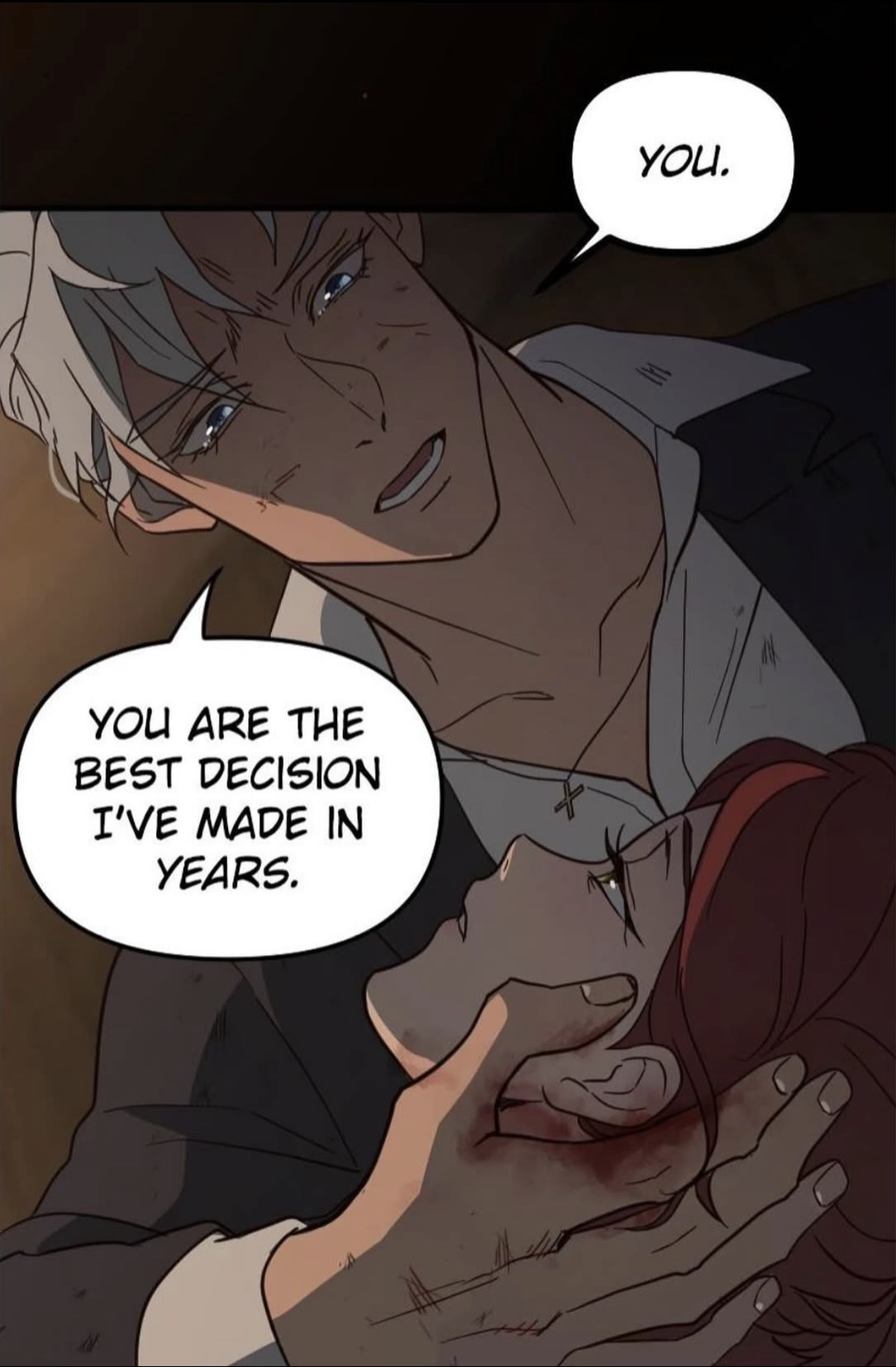
You might not regret it.
You can buy your copy of Mafia Nanny through Penguin House.
“Stay With Me”: The Perceived Tragedy of Miki Matsubara
If you’ve been on TikTok, Instagram, or YouTube in the last three years, you’ve no doubt heard this song:
And like much of the internet, you’ve probably read or heard the same lurid variation of this caption:
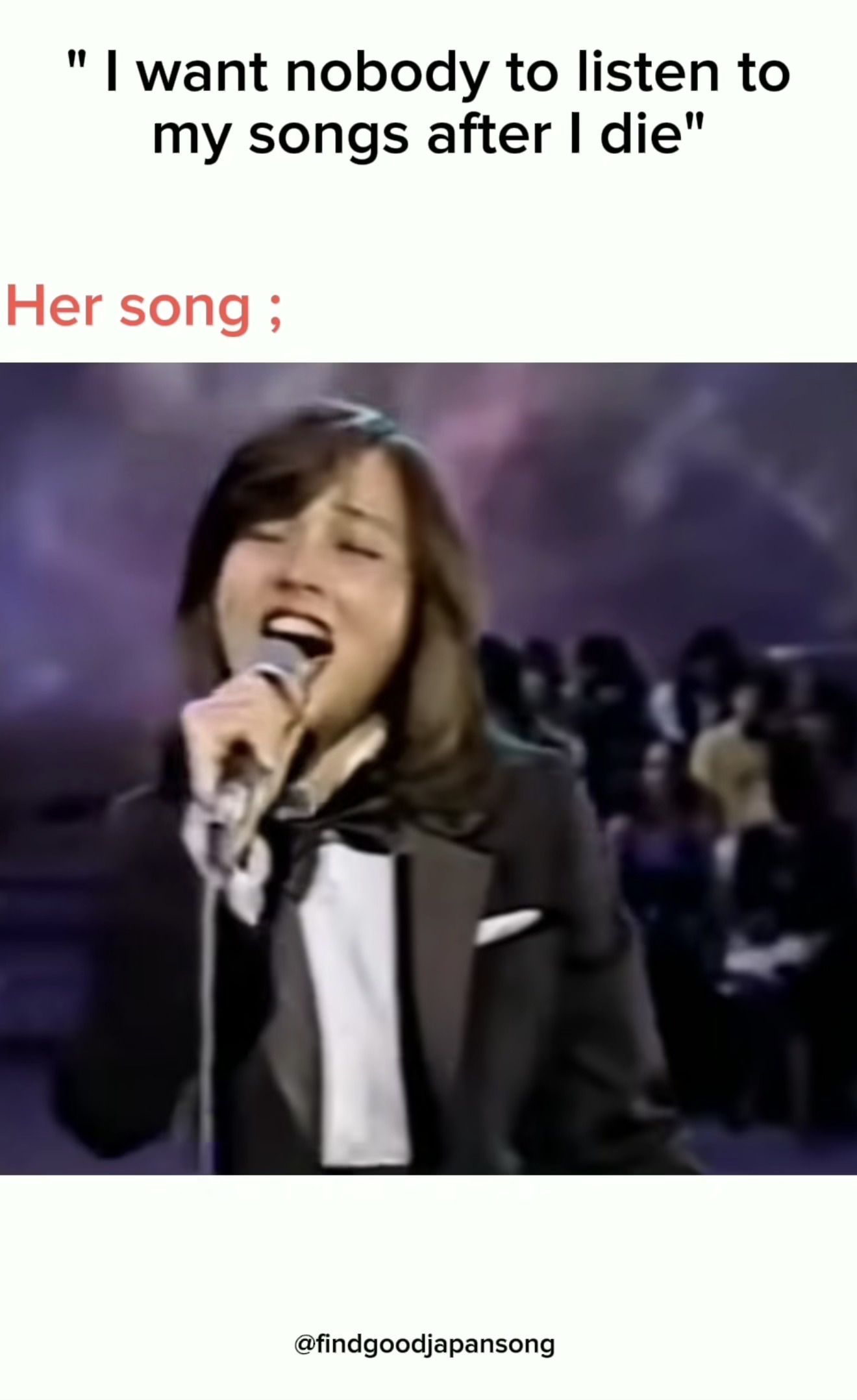
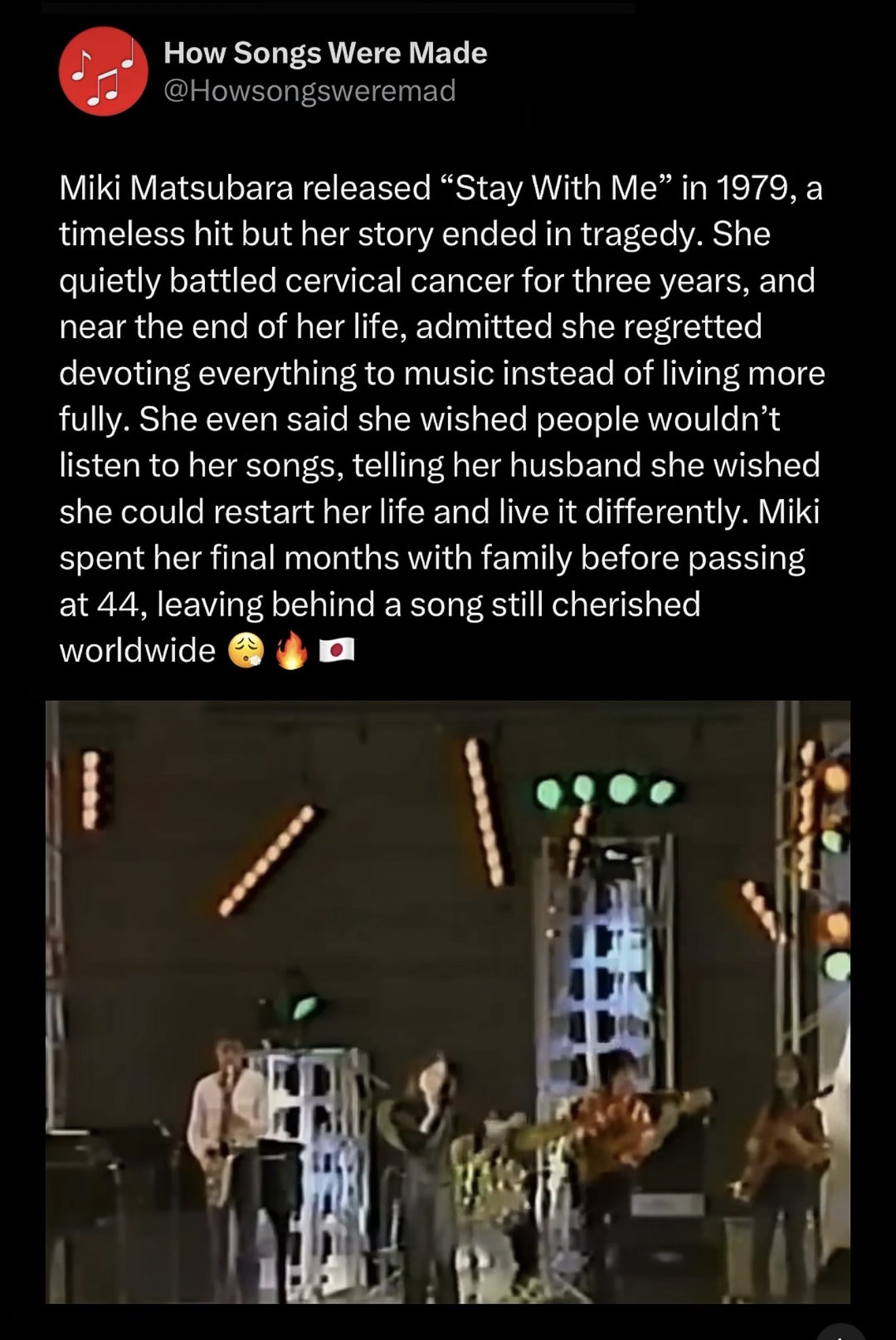
The Instagram clickbait worked; I found myself fascinated by Miki Matsubara—who was this mysterious woman with the jazzy, soft-rock, and yet somehow also disco vocal pipes (the holy triad) that tried to burn her own legacy to the ground? I became determined to figure out what could have driven her to such an extreme reaction.
Spoiler alert: It wasn’t much.
Miki Matsubara rose to fame in 1979 with her track “真夜中のドア〜Stay With Me,” launching a career that would span ten studio albums, multiple compilation records, and a successful pivot into anime singing and songwriting. If Tatsurō Yamashita is considered the reigning King of City Pop,19 then Matsubara was its Queen.
Matsubara was diagnosed with late stage uterine-cervical cancer in 2001, and like most who are given that type of terrible news, had a reckoning. Matsubara retreated from public life, cutting herself off from her former bandmates and business associates with an email, effectively ending her music career and slamming the door shut on any efforts for further contact. It was reported that during this time period, she burnt her sheet music and recordings.20 Matsubara died four years later on October 7th, 2004, surrounded by her family in Osaka.
Matsubara’s decision to disconnect from her work was unfortunate for her disappointed fans and colleagues, but also terribly common. The National Cancer Institute21 lists overwhelm, fear and worry, stress and anxiety, hope, anger, sadness and depression, gratitude, loneliness, and guilt as the most common reactions to a cancer diagnosis. To a terminal cancer diagnosis, it additionally lists guilt and regret:
When a loved one is diagnosed with cancer, especially if the prognosis is poor, anticipatory grief may set in. This type of grief occurs when you start to mourn a loss before it happens. It’s common to experience anticipatory grief as you begin to imagine life without your loved one or as the patient grieves the loss of their health and the future they had envisioned.22
If this reaction is so common that it’s listed on a pamphlet, then why is the current internet still painting this woman’s reaction in such lurid lines? At the time of writing, twenty-two years have passed since Matsubara’s death in 2004. It begs the question: haven’t we changed in America since then? The way the media has depicted female-identifying musical artists has changed somewhat since the days of Britney Spears (the most glaring example is the discussion around white American Chappell Roan establishing hard boundaries from fame-related stalking and harassment),23 and even more so since 1979, when Matsubara’s single “真夜中のドア〜Stay With Me” erupted onto the charts. I won’t attempt masquerading as an expert on Japanese fan culture of the 90s, let alone the 80s (though I highly recommend watching Satoshi Kon’s 1997 psychological thriller The Perfect Blue for some context), but I will introduce a contrasting example of media treatment from my own lived experience: David Bowie’s death from terminal liver cancer in 2016.
When the news broke the afternoon of January 16th, I immediately burst into tears, surprising my confused coworkers with a dash to the bathroom. My reaction hadn’t been a shock to me: I’d loved his music since I was a teen, especially during my years studying experimental theater. The rest of the world grieved as well, recounting his long career with tribute posts and articles. The rock music legend was a cultural sensation, reinventing himself as the decades passed from his breakthrough single “Space Oddity” until his death two days after the release of his final album, Blackstar. The album was a calculated release, the final stroke of a master performer who knew how to wield the ever-evolving Rolodex of his personas. CNN’s analysis of the album at the time gave the artist a generous level of grace:
…it’s maybe too easy to read unintentional meanings into these songs. Only Bowie knows for sure what he was saying. As an always-evolving artist who challenged notions about genres and gender, he is keeping his audience guessing from beyond the grave.
This past January was the tenth anniversary of David Bowie’s death, and still, still the headlines in the English-speaking world have remained more respectful than that of Matsubara:
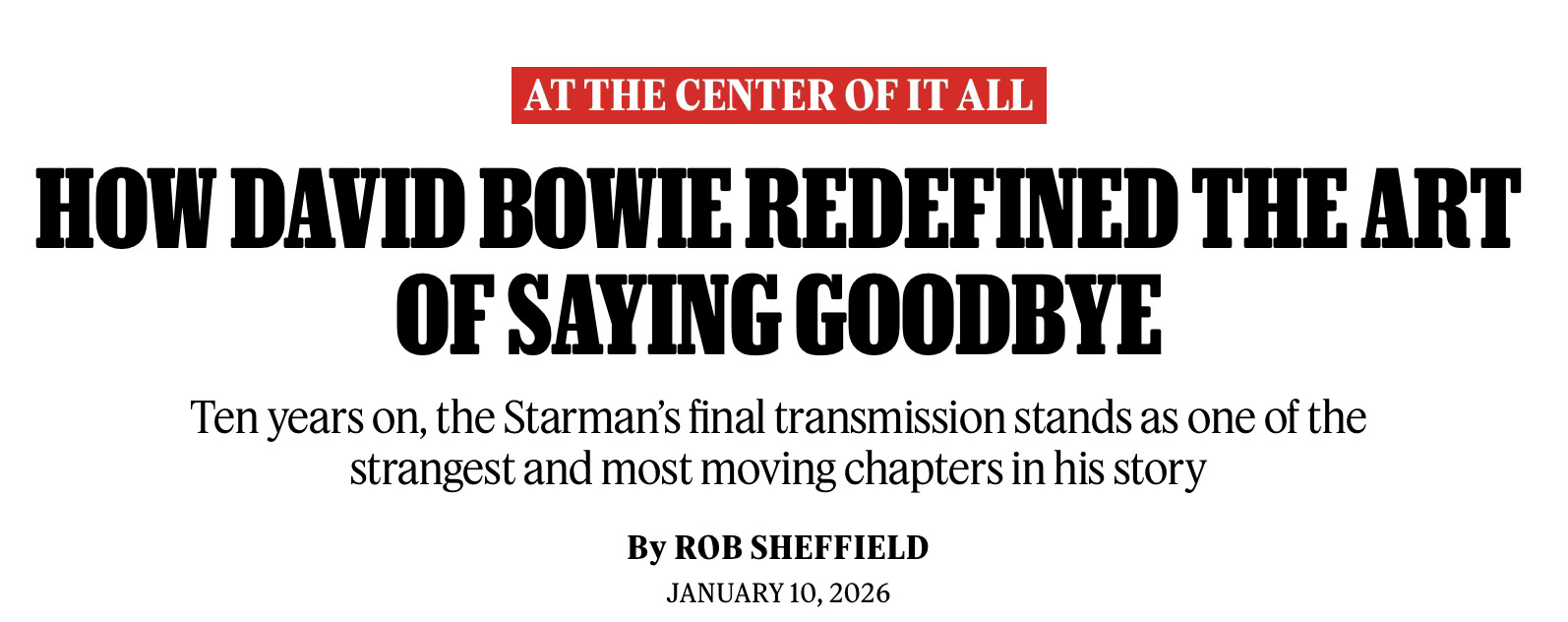


Naturally, there are other noteworthy discrepancies in their careers (the primary one being that Matsubara never reached the same level of critical global acclaim that Bowie did during his lifetime). Despite that and many other differences (like Matsubara being both female and Asian, and the unfortunate discrimination that comes with each alone and together), I still found myself searching “David Bowie death,” “David Bowie cancer,” “David Bowie death controversy,” to see if I’d find any lurid clickbait. Not surprisingly, I found none. However, while I was searching, I stumbled onto a post from The Conversation Project, an initiative of the Institute for Healthcare Improvement that has created various tools to initiate end-of-life care conversations with loved ones:
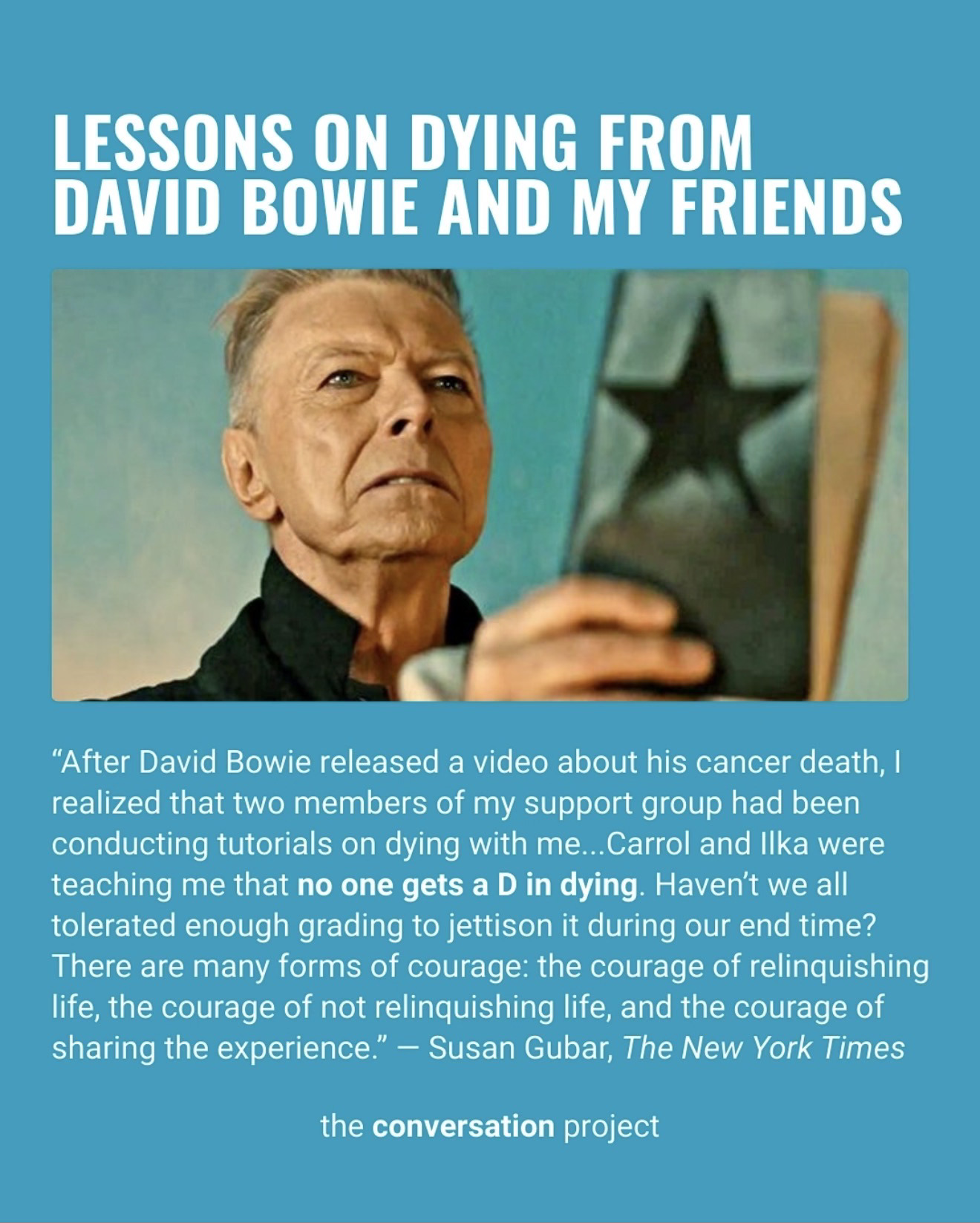
It was a quote pulled from Susan Gubar’s The New York Times article “Lessons on Dying From David Bowie and My Friends.” She had an ongoing series called Living With Cancer, which seems to have ended in 2021, that addressed various components of living and thriving with terminal illness.
I liked her quote a lot. “No one gets a D in dying.” It felt like it hit at the central point of the issue I was feeling: the narrow way we still ascribe value to certain types of dying behaviors. In Matsubara’s case, it was the underlying judgment in those clickbait posts that perhaps Matsubara’s regretful end was a tragedy, and in that way, she had fumbled the landing of death, failing to exit this life with the dignity that one is supposed to have amassed before they go.
Curious, I became determined to see what the general consensus was for a “good death.” As the Matsubara clickbait I’d seen had been in English and that my counterpoint was the British-born Bowie, I followed American and British resources. Then I remembered: Health care in America is not a universal right! So I decided to go with a British source.
Marie Curie, Britain’s End of Life Charity, maintains that the following principles constitute a “good death”:24
- pain and symptom management
- emotional and spiritual support
- focusing on what matters most to you
- co-ordinated and easy-to-use services
If we apply these principles to the details of Matsubara’s death, we see that the manner in which she passed checked off each point. That conclusion makes one wonder in broader strokes: What if Matsubara had chosen to go the way of Bowie? In an ideal, kinder world, would she have been given the same grace today on the internet, the same grace Bowie’s legacy still has if she had chosen to work her final moments out through her art?
It’s hard to say.
These days, I’ve found Miki Matsubara’s Compilation album to be a balm in the ever-growing pile of daily horrors, a reminder that things will not always be terrible, and that life, and consequently pain, will one day pass. But it’s her hit “真夜中のドア〜Stay With Me” that I keep returning to again and again.
It’s a sad song, reflecting on the end of a relationship and wishing for the beginning when everything was right. With world and domestic events being what they are, and with the looming horror of how they all could become far worse, it’s no wonder that this song is still so appealing past the 20th anniversary of her death. Matsubara’s voice is hopeful, goading her lover to remember, as if by remembering together they can rekindle their feelings, and from there, repair.
My hope after contemplating the life and death of Miki Matsubara is that we can remember and honor the lives of everyone around us, in all the ways that people end up dying, with the same level of respect to those who have “done it right.” Not everyone can be David Bowie, though it is fun to try…
(A fun project I did with my friend Michael Lukk Litwak.)
Maybe ‘It Was Just an Accident’: a Review
*This essay contains spoilers, so skip ahead if you so feel inclined!
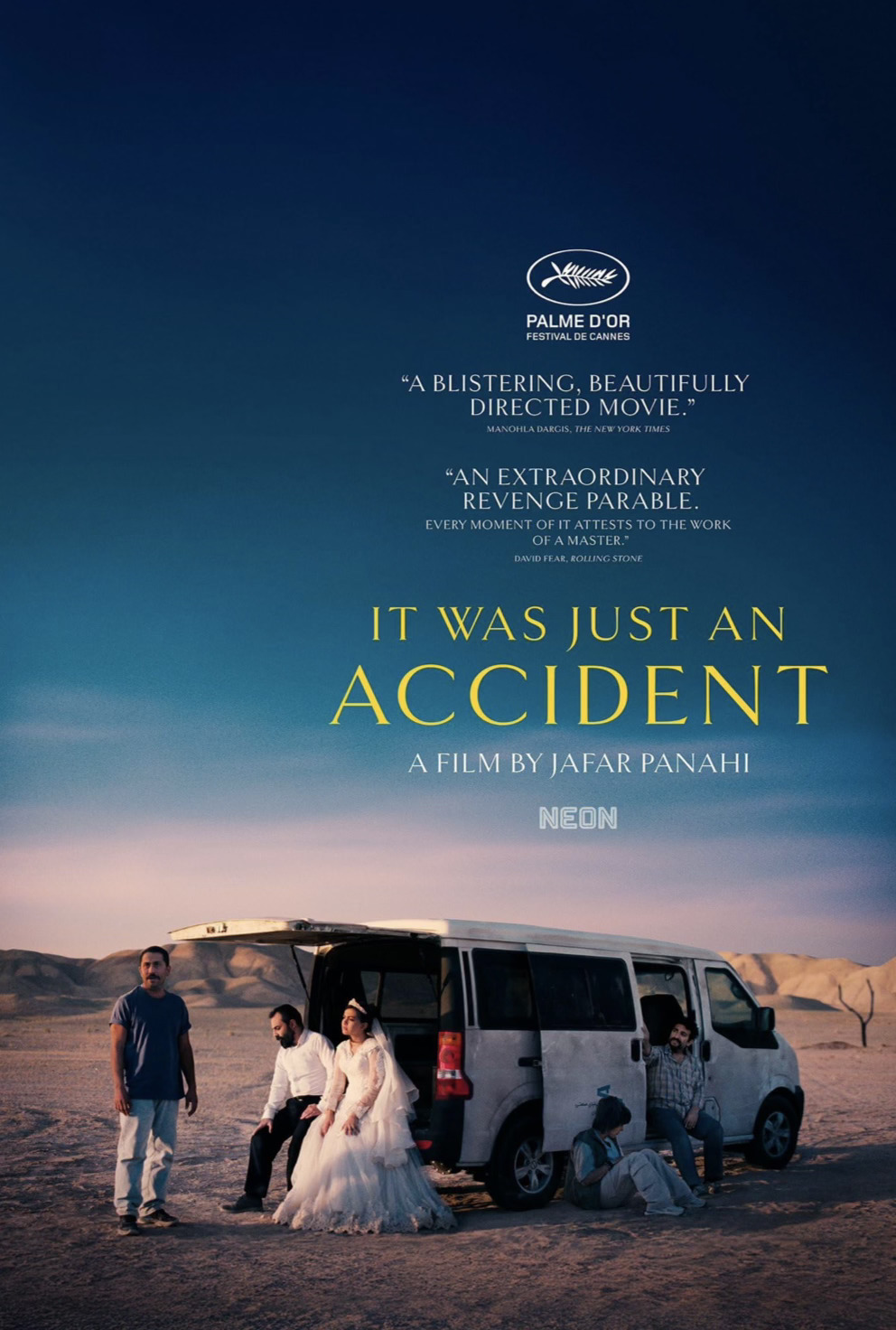
My husband turned to me: “I think I have a comedy for us. It’s called It Was Just an Accident.”
“What’s it about?”
My husband squinted down at his phone and then back up at me.
“Political torture,” he glanced back down to verify, “in Iran.” He checked the review again. “Yeah…”
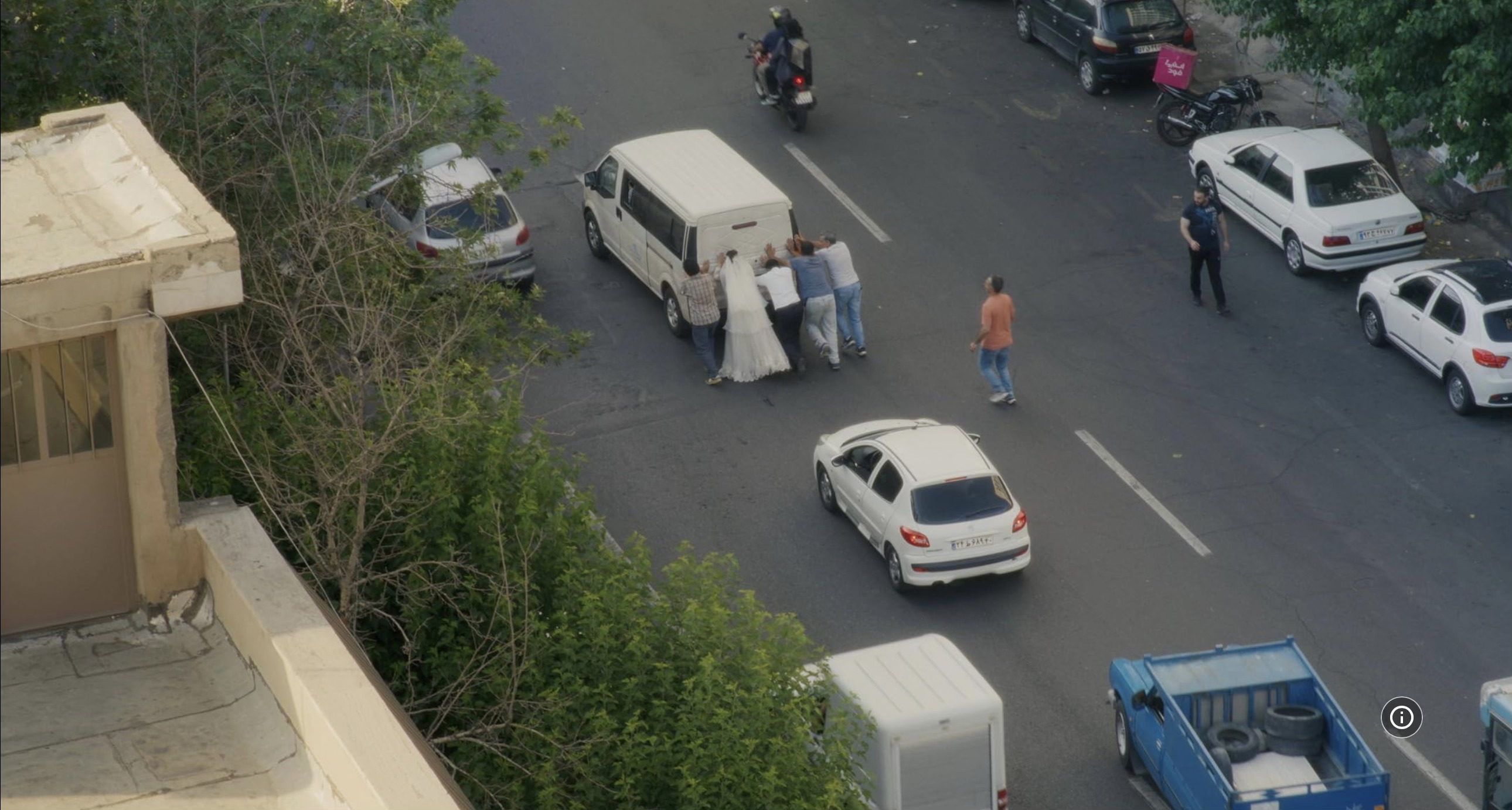
He wasn’t wrong. At first glance, Jafar Panahi’s It Was Just an Accident is a revenge thriller: Former political prisoners take justice into their own hands when one of them, Vahid, happens upon the man who sadistically tortured them years prior. Or, Vahid thinks it’s the man. He’s about 90% certain it’s the man.
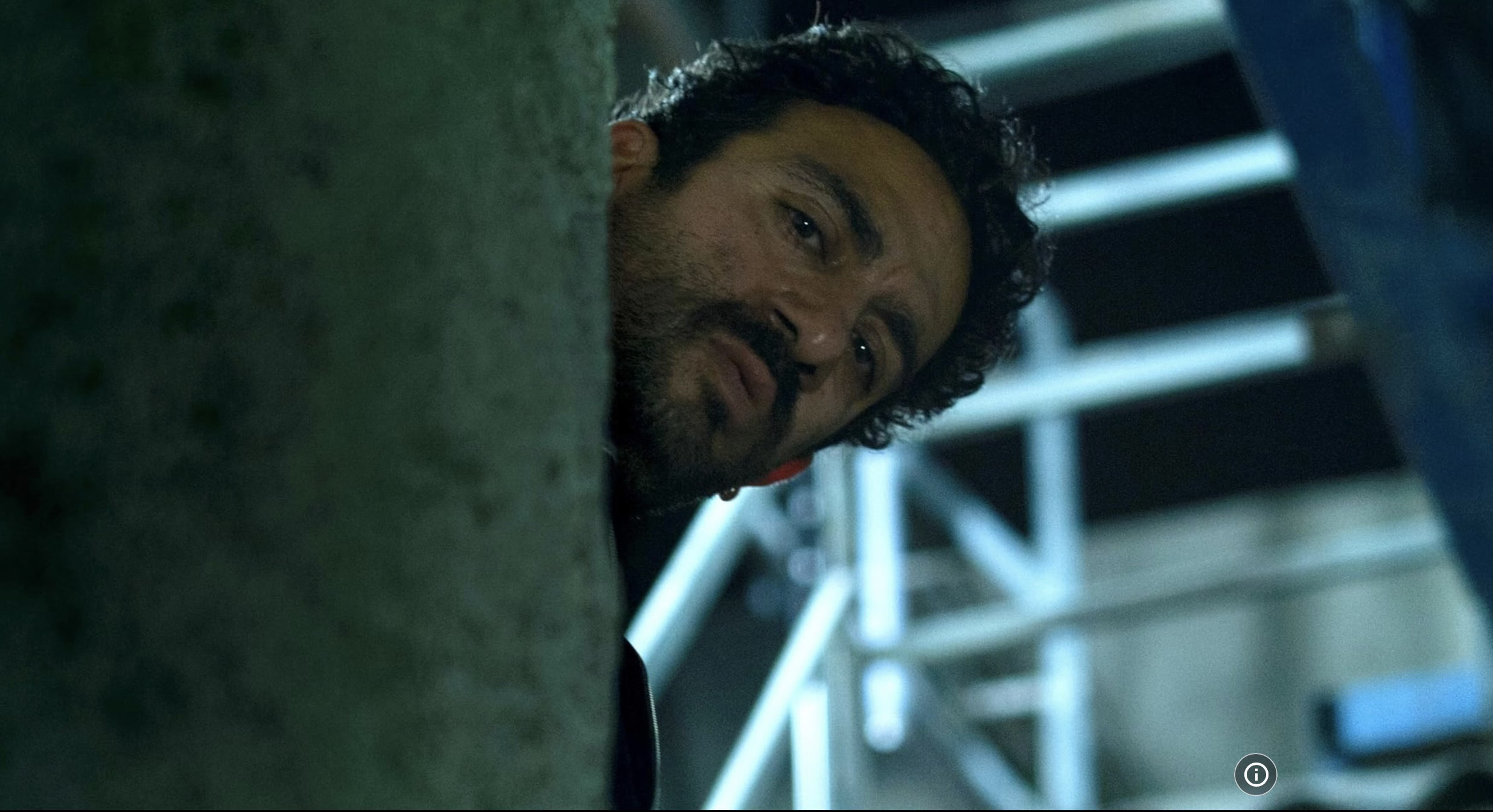
He’s about 50% certain it’s Peg Leg.
You see, while he was in jail for trumped-up sedition charges, he was blindfolded during much of his torture. This is where the movie departs from your traditional thriller into the subgenre of a comedy:25 Vahid kidnaps Eghbal, but then pauses mid-task in burying Eghbal (Peg Leg) alive in the desert because he really isn’t sure it’s the same guy. We the viewers are thrown off kilter; it’s funny, seeing this man go about his mission to kill in a tableau straight out of Waiting for Godot. It’s funny to see him frustrated at life’s complexity as he stands, with his humble humanity, at the scales of justice. We the viewers are then thrown into an unexpected, jarring, and comedic journey as Vahid happens upon other survivors, collecting them together like pearls on a string as they all try to figure out if indeed Peg Leg is Peg Leg, and then if Peg Leg deserves the same barbarity that he had doled out to each of them long ago.
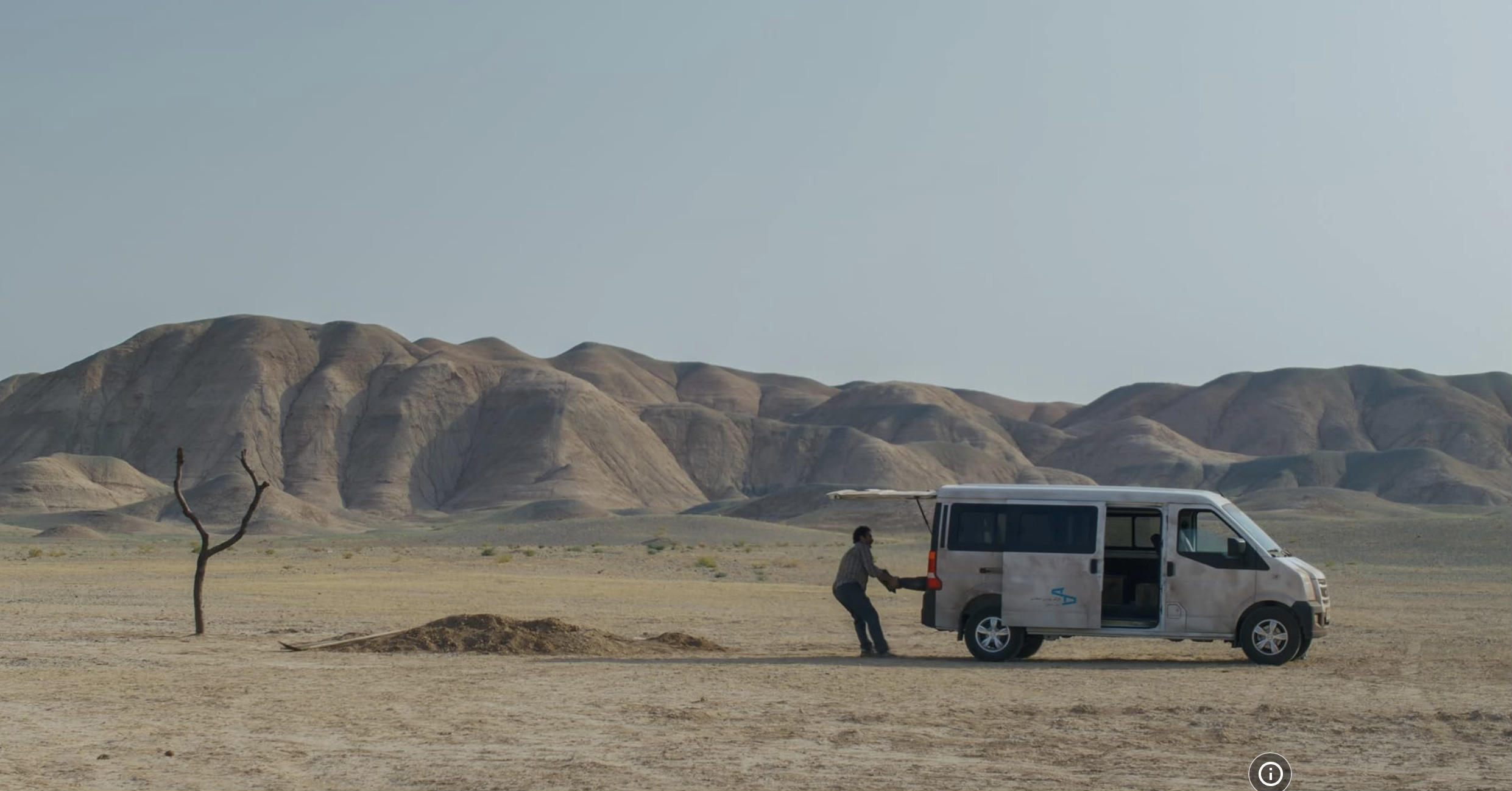
The second time we find our friends in the desert (once it has been established that they have, in fact, captured the bona fide Eghbal) the camera pans again to a second Godot tableau, except this time, it’s addressed.
After debating the nature of justice and war, Hamid (another victim of Eghbal) sits down next to Shiva (also a victim), whose back is to that Godot tree:
Hamid: From afar, you reminded me of that play we saw. With just a tree.Shiva: Waiting for Godot.Hamid: We’re exactly in the same situation.
Panahi’s intentional reference is revealing. Waiting for Godot is a play written by Nobel Prize winner Samuel Beckett, a man no stranger to political instability and injustice, having been born in Ireland in 1906 before Ireland’s partition in 1920. His play is forever inscrutable to interpretation; an existential house of mirrors stripped down to the most basic of sets, characters, and plot, and ultimately considered core canon in the Theatre of the Absurd. The two main characters, Vladimir (Didi) and Estragon (Gogo), spend their time waiting for a mystery man named Godot to come and save them. The play ends without Godot’s expected arrival. Because of its enigmatic nature, the play can be taken up like the bowler hats of its characters and placed on different interpretations and lenses. One can’t help but feel that Panahi used this approach on the title of the movie and how he chose to depict the nature of revenge, and also perhaps how Panahi might feel about critics labeling his movie as a revenge tale.
I really loved how soft the film was, and yes, despite its subject matter, I would consider it soft. With each character’s hesitation to mete out justice to Eghbal, the film refused to sink to the same level of violence that was perpetrated against its main characters. It refused to be anything but humane to its supposed villain, which I would argue is why the film is far more subversive than at first watch: The villain of “It Was Just an Accident” is not Eghbal, but rather how our very human desire for clear-cut certainty in this life drives us to extreme acts.
Let me explain. In the film’s first topsy-turvy twist, we open not on Vahid (a very Godot-coded character), but rather Eghbal driving his daughter and his pregnant wife across the darkened countryside. Eghbal’s daughter is a rambunctious child, bouncing up and down to get her father’s attention, clutching an iPhone, blasting pop music. The first dose of the movie’s tension is the distraction cut clearly into her father’s face. After some entreating, he complacently turns up the volume to appease both wife and child. When the loud music distracts Eghbal enough to accidentally hit a dog, Eghbal immediately takes personal responsibility, gently pulling the car over and stopping it to verify the damage. He doesn’t take anything out on his daughter or wife, just sits in his grief over killing an innocent creature.
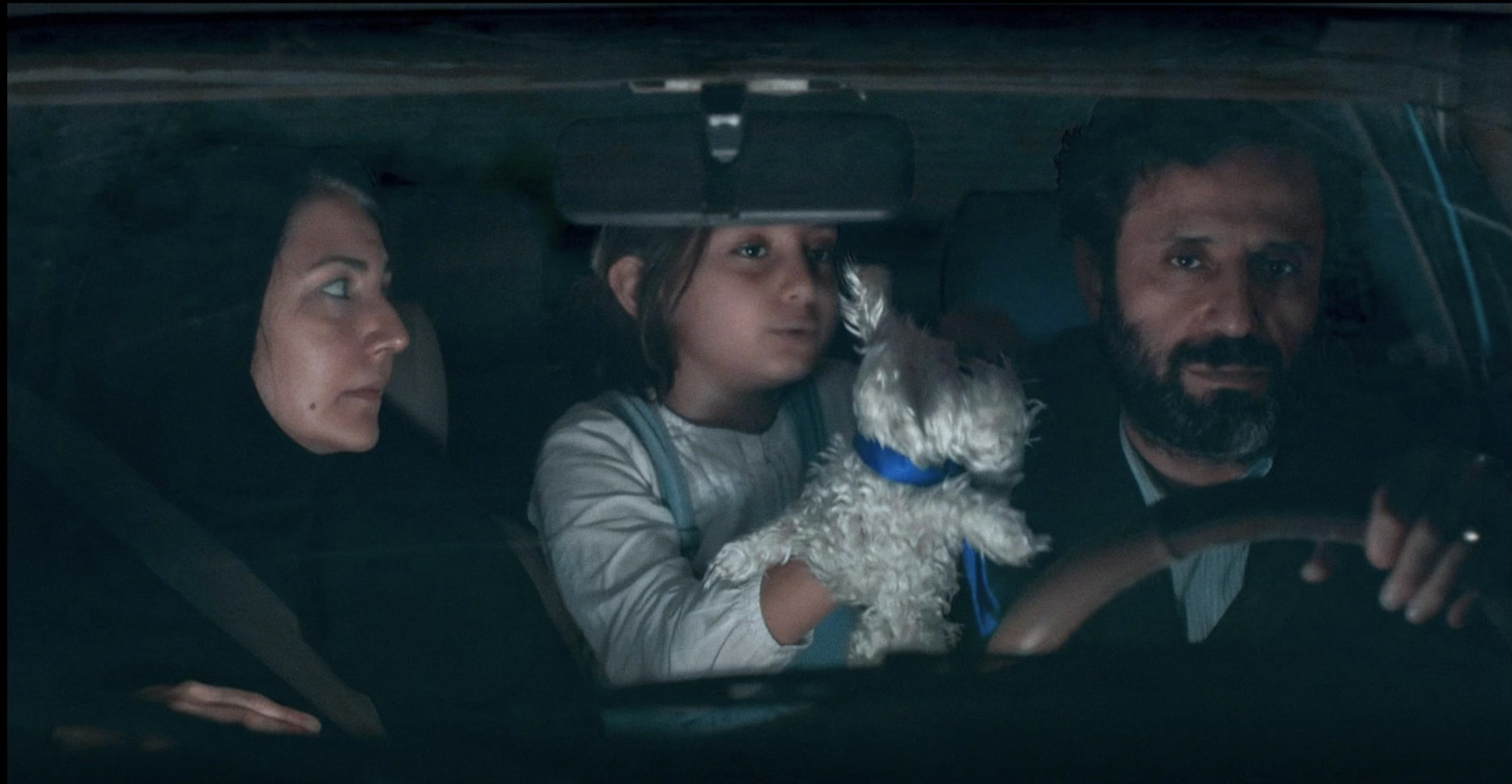
The scene humanizes Eghbal, an exhausted-looking father whose already-thin patience has just been broken by the unexpected tragedy. We as an audience are immediately on his side, so much so that later when we learn about the unspeakable atrocities he has committed on Vahid and the others, we, too, share each of the characters’ doubts. It forces the viewer to confront their own desire for explicit certainty.
Is it terrible to want retribution for injustice? We learn the second time in the desert that Eghbal undoubtedly committed these crimes. Still, there is doubt in the characters, indecision to wreak justice on the man who has wronged them. Even Hamid, with his absolute, righteous certainty, is shown comically, exposing his bravado for the lingering doubts he can’t (understandably) face.
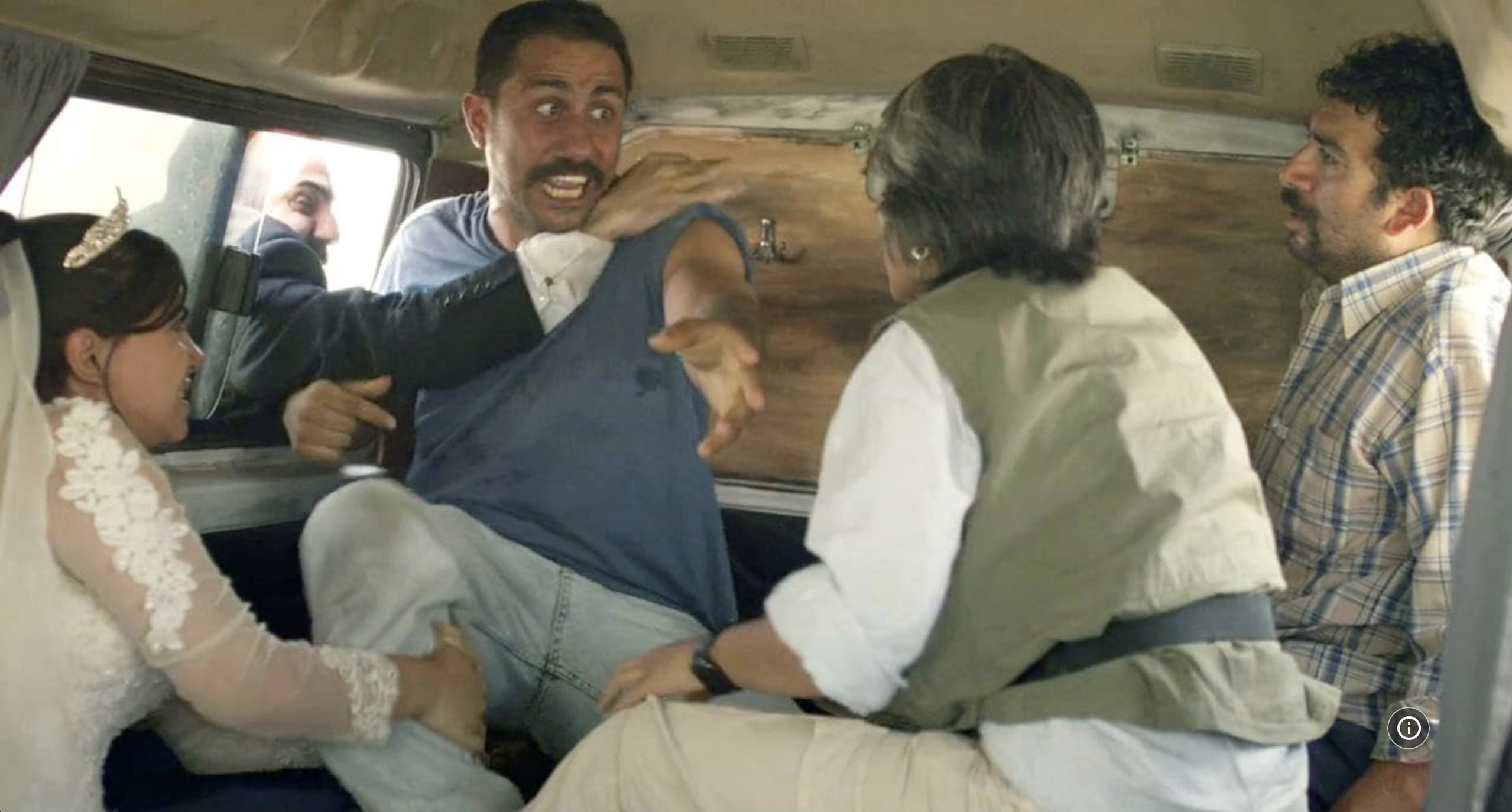
Just as we the viewers are certain that Eghbal will get his just desserts, Eghbal’s phone rings. It’s his precocious daughter, distraught, as her heavily pregnant mother has just fainted. The movie twists again: Our group, divided and conflicted, ultimately decides to take mother and child to the hospital for the birth. When the receptionist asks who Vahid is in relation to the patient, the daughter (clad in her pajamas) states that he is her uncle. It’s a bold move, calling Vahid family, twisting our plot further as Vahid is now responsible for both Eghbal’s daughter and his wife’s medical bill. Vahid wearily accepts his fate, and the camera cuts hilariously to some time later in the waiting room. Vahid had bought the child a snack and stayed by her side. When the baby boy is born, Vahid goes out to retrieve money to tip the hospital’s nurses,26 and even gets money from Goli (Golrohk), who Eghbal raped. We learn that Hamid has left, his righteous anger of the day now spent in the tediousness of their wait. It’s a subtle moment, but still powerful: The characters have once again failed to exact revenge on Eghbal.
Eventually, all that’s left of our main characters are Vahid, Shiva, and Eghbal, at the base of a different tree in the countryside. Finally, the viewers think, the revenge bit! With a blooming tree! But again, Panahi subverts our expectations. Tied to a tree, Eghbal is forced to endure Shiva’s try at torture. She slaps him, not violently enough to hurt more than a sting, and berates him, recounting her own torture with words that are harsh but not vicious enough to cause lasting damage. It is her very inability to become the torturer that Eghbal was to her that finally breaks him into his sobbing apology. Shiva humiliates him with her inability to fully enact revenge, collapsing next to him and weeping alongside him. She eventually clears the scene, letting us remember that Eghbal is still the same man that we saw in the beginning. Vahid then enters the frame, throwing the audience another curveball by cutting Eghbal free and giving the man the means to escape as well as the directions in which to do so. We are never given the revenge that we were promised.
Later, though the time is never directly given (though we can imply it is the next morning), Vahid hears the squeaky approach of Eghbal’s prosthetic leg. Or is it? We are not shown Vahid’s face, only the back of his head staring at a staircase and a frame that doesn’t show what’s at the top of the stairs. We have no way to gauge what he’s thinking and feeling, or a way to determine if what we’re hearing is Eghbal. We the audience are forced to come to our own conclusions as the squeaks pause, and then squeak away.
I found the movie incredibly powerful. Like Godot, Panahi keeps his film as simple as possible, making the film easily accessible to those outside of Iran and those who are not familiar with the specifics of Iranian law or customs. Similar to Godot, not much happens by way of plot. The way Panahi structures his film as a thriller, we expect to learn something, or to have our characters learn some greater truth about themselves. What we see are characters eventually growing weary and giving up, no wiser than they were at the start. It could be argued It Was Just an Accident is a modern-day retelling of Waiting For Godot like Hamid asserts in the desert, operating beyond the limits of the screen by becoming a tool with which the viewer can project their own interpretation onto. Or is it? The structures of the plots are not similar, so it’s not a clear-cut a-to-b, though the implication that aimless action is the same as waiting is compelling. However, simplifying both works to this comparison reduces the important cultural contexts of each, leaving the reference open to interpretation again and tossing out our (as well as Hamid’s) certainty once again.
All that can be said, I think, is that the wonder of this film lies in Eghbal’s wife’s line at the very beginning. After they hit the dog, she gives solace and thesis as much to her daughter as well as to her husband:
Eghbal’s wife: Sweetheart, the roads aren’t lit. These poor animals get run over. It was just an accident. What will be will be. God surely put it on our path for a reason.Eghbal’s daughter: He killed a dog. God has nothing to do with it.Eghbal’s wife: It’s not his fault. He didn’t do it on purpose.
The car then breaks down, depositing Eghbal and his family at the doorstep of the man he once tortured. The juxtaposition of these two scenes is funny on a second viewing, like Panahi is suggesting that the horrors of life can be funny, if you look at them a certain way.
Or not. You can take the film as you will.
Salvage in a Dystopian Future: Tim Chawaga’s Sci-Fi Debut, Salvagia
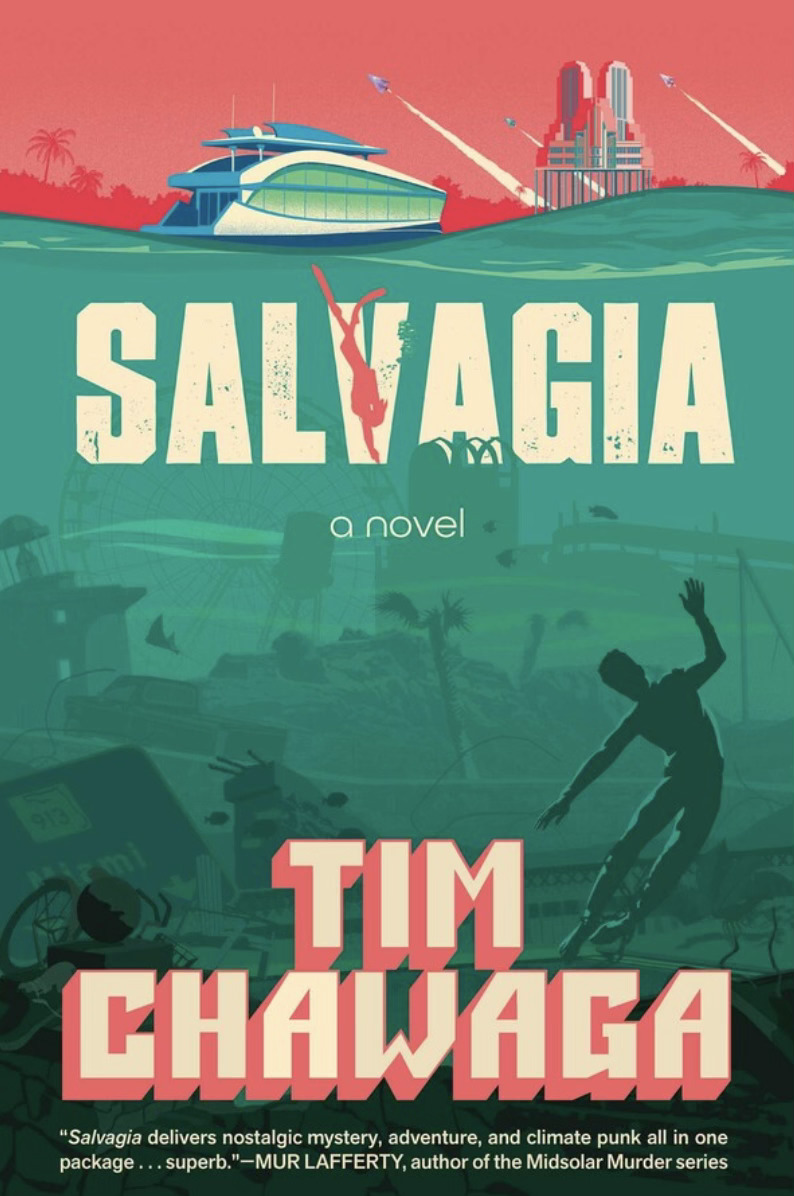
Tim Chawaga’s debut novel follows Triss Mackey, a salvage (or ‘salvagia’) diver in a future flooded Florida coast. We open with Triss finding a Keds Champion Original Canvas sneaker, and by page 6, readers are plunged into a twisting, dystopian, climate-change, noir, cat-and-mouse murder mystery that leaves your heart pounding, your head spinning, and you unready to step away from the last page.
Inspired by John Macdonald’s Travis McGee series and Kim Stanley Robinson’s New York 2140, Chawaga’s novel seamlessly blends sci-fi and mystery. It also has one of the most plausible sentient (sorry, semi-sentient) machines I’ve ever read in a sci-fi novel.
I had the opportunity to talk with Tim about this.
Me: I know that you’ve spent some time working in tech. Did that have any influence on the world-building of your semi-sentient machines? When I read Salvagia, it was really cool to see what felt like a representation of symbolic artificial intelligence, especially in a book that tackles climate apocalypse.Chawaga: Definitely. I occasionally work with AI at my job, and while there are some productivity benefits that trickle down to me, I think AI as we currently know it (as in, LLMs or GenAI) is designed to be profitable first and useful second. And it’s not really intelligent. By definition it can’t be.I wanted to create something that had the opposite priorities, and what I would consider to be closer to a true intelligence, which would require it to have at least a little free will. Because a semi-sentient can’t be fully understood, it’s difficult to control it. If it can’t be controlled then that means it has some autonomy, and as long as it has some autonomy it is unpredictable, and can’t be fully profitable (which is part of why no one builds CabanaBoats anymore in my book).Behaviorally, the model for Floating Ghost is my dog, who is a rescue. They’re similar in that you don’t quite know their history, you can’t really talk to them. They have behavior that you can deduce might be related to trauma but you can’t ask them about it specifically, there’s always this gap. And to get them to do anything you have to get them excited about doing that thing, you can’t just make them.The work of understanding and collaborating with something so inherently different is rewarding, and humbling. Among other benefits, it greatly expands your vocabulary for empathy. Commanding something, or shunting off tasks to something that’s just a regurgitation of stuff we already know cannot improve you, the point of it is to take things away from you.
Come for the sci-fi mystery, and leave with the cherished hope that maybe with enough trust in each other, we can rebuild and prevent a further- damaged future. If you like robot-gators, futuristic racing, climate punk, and good old-fashioned murder mysteries, then Chawaga’s book is for you.
You can purchase Chawaga’s book at Barnes and Noble or Bookshop.org
I Spy With My Little Eye: Vivid E-Paper
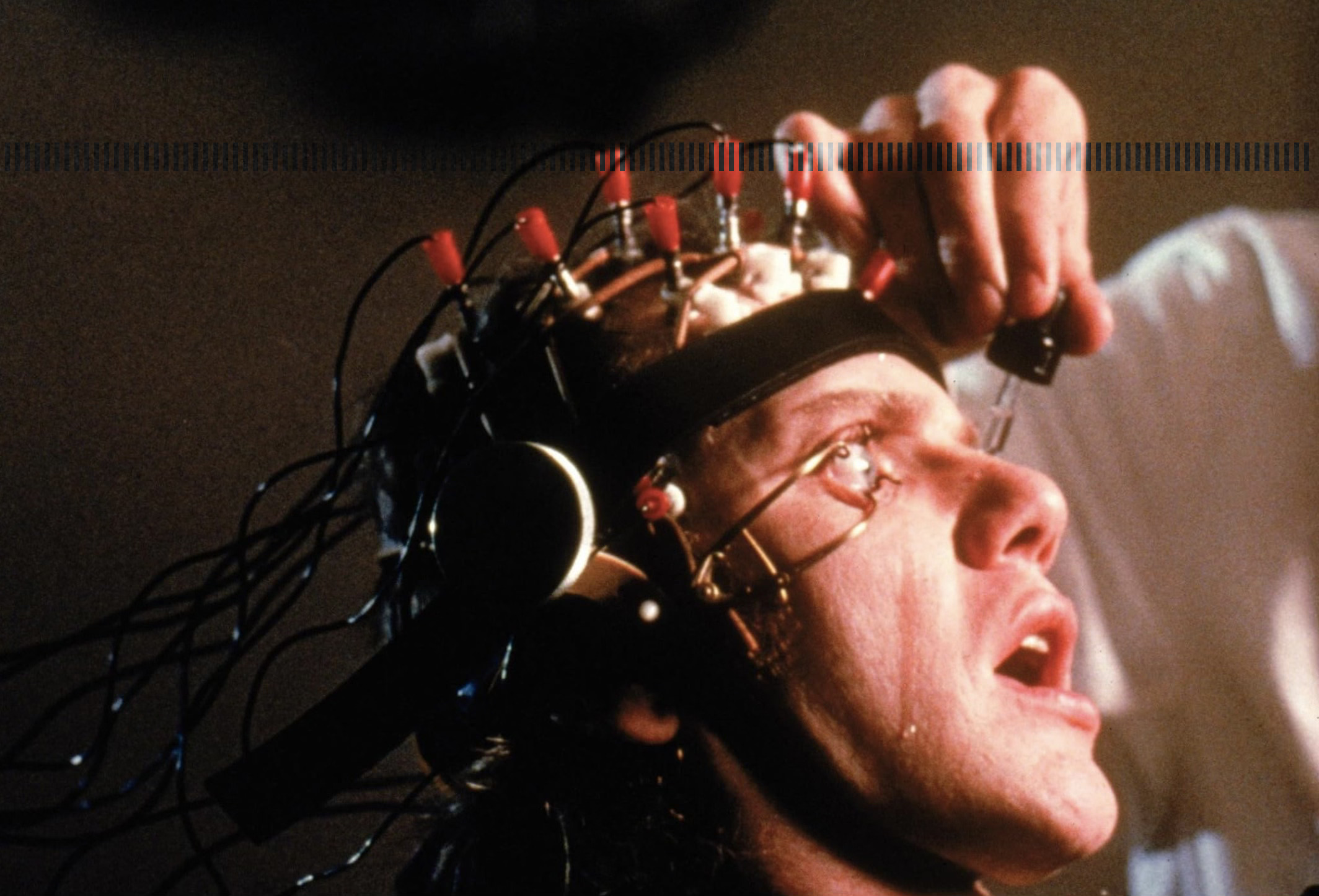
Gone are the days of the white and black square pixels of the Tamagotchi (R.I.P. to my baby Dino. You were a hassle.) Turn on your e-reader that’s powered by ambient light and you’ve got a similar contrast. You also (more likely than not) have a color display, but unfortunately, not a high resolution.
A new study led by Kunli Xiong of Uppsala University (published in Nature)27 details how a new kind of display can show color video on extremely small screens. The kicker? The screens are two square millimeters across.
What’s being proposed are electrochromatic nanoparticles (consisting of red, blue, and green subpixels) controlled by electrical signals. In layman’s terms: the future of technology will not only be bright, but also colorful “beyond human perception.”28
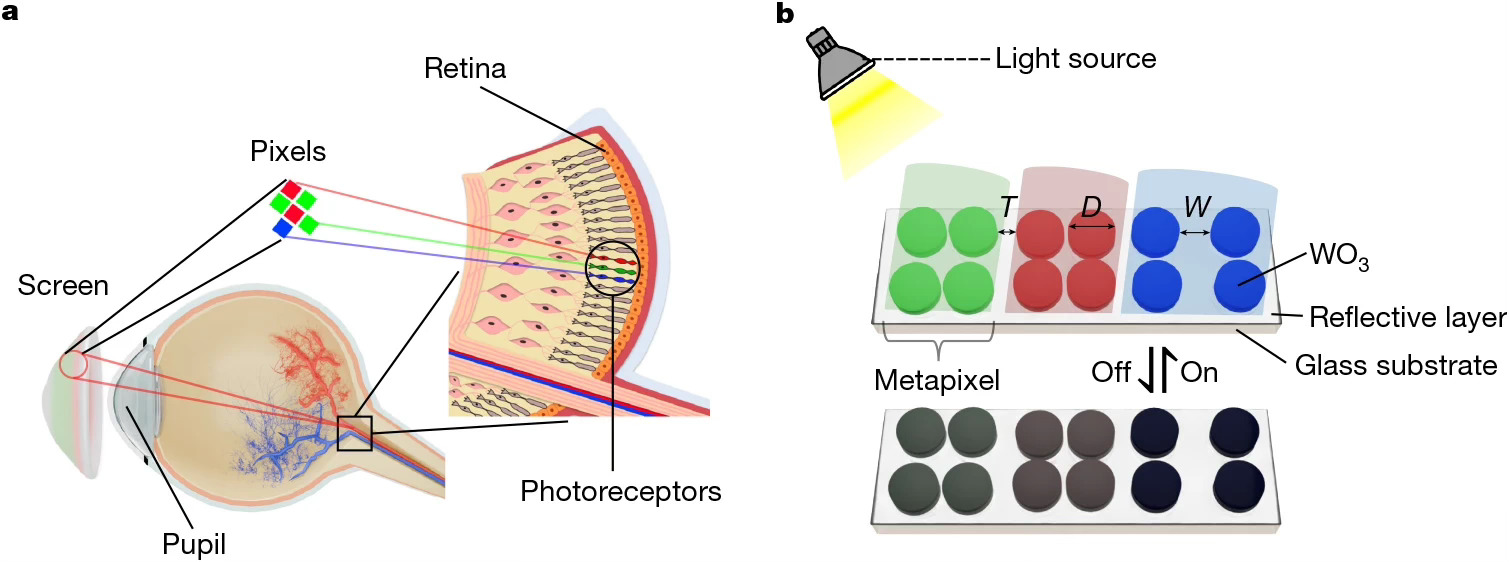
It’s an incredible development, but what Simon Makin’s article covering the study in Scientific American points out is that “the necessary electronics for such a high resolution do not yet exist.” Based on that assertion, I have to wonder: What will the world look like when to the human eye, a video of a rose looks no different from the real one on a bush? Will our brains be able to tell the difference? Or rather, will it not matter as much as admiring an oil painting in a museum?
Only time will tell if this technology will be sensational or not. Based upon Kunli Xiong’s estimations, we still have at least ten years to figure it out.
That’s it for now! If you need me, I’ll be preparing for my job on February 8th in Santa Clara, painting the invisible lines.
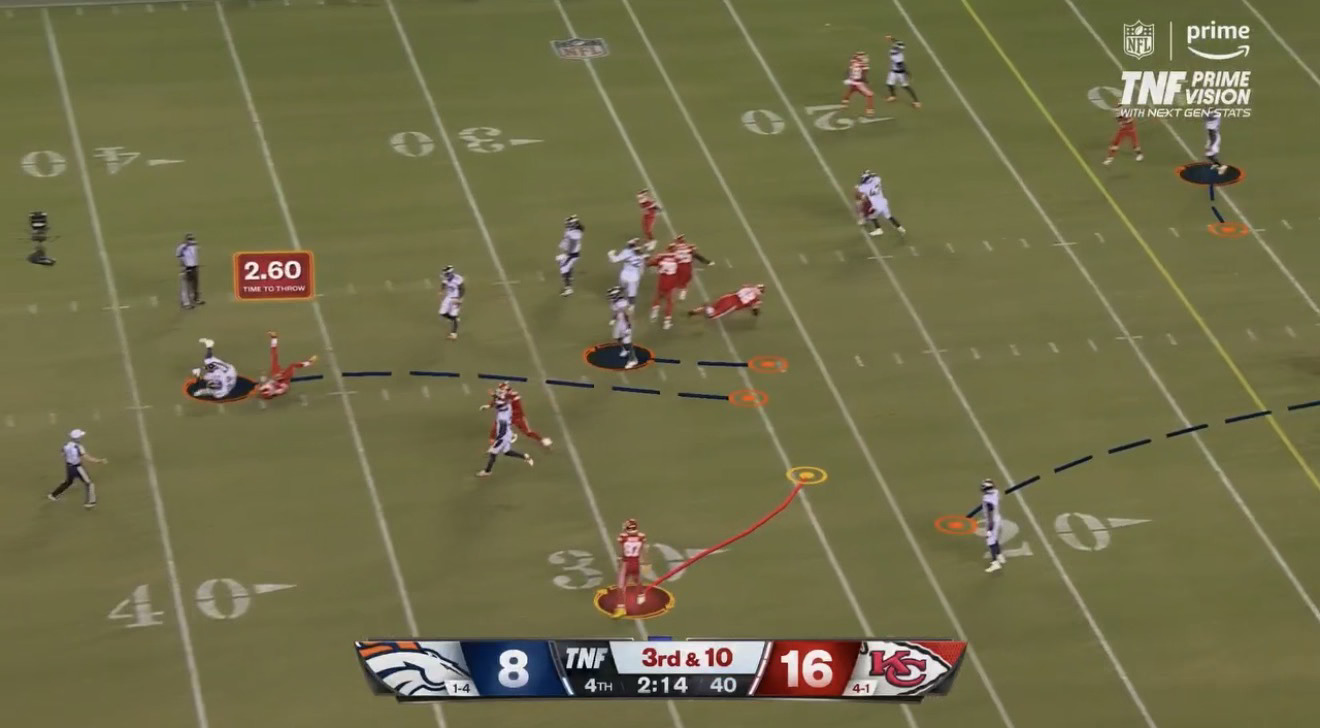
It’s a thankless job, but someone’s gotta do it.
Thanks for reading Lauren's Lurid Things! This post is public so please feel free to share it.
Ta-ta until next month!
XOXO
Lurid “She’s coming at it from a European perspective” Lauren

https://www.nytimes.com/2024/06/24/arts/lampshade-maker-ivy-karlsgodt.html ↩
https://www.buildingconservation.com/articles/lighting/lighting.htm ↩
https://jaihokisan.in/sericulture-the-secret-and-benefits-of-silk-making.html ↩
https://biddlesawyersilks.com/how-is-silk-made-a-step-by-step-guide/ ↩
https://www.sciencedirect.com/science/article/abs/pii/S0016718518301726 ↩
https://www.brooklynpaper.com/bed-stuy-artist-makes-lampshades-cool-again/ ↩
https://www.printmag.com/designer-profiles/ace-of-shades-ivy-karlsgodt/ ↩
https://www.cbr.com/the-mafia-nanny-violet-matter-interview/ ↩
https://www.theflagshipeclipse.com/2025/02/19/the-mafia-nanny-creator-violet-matter-talks-season-3-and-print-release/ ↩
https://www.rollingstone.com/music/music-features/japanese-city-pop-returns-light-in-the-attic-compilation-pacific-breeze-822663/ ↩
https://www.yokogaomag.com/editorial/miki-matsubara-city-pop ↩
https://cancercenter.gwu.edu/news/managing-grief-after-cancer-diagnosis-and-loss-guide-patients-and-loved-ones ↩
https://www.elle.com/culture/music/a62163380/chappell-roan-yelling-photographer-mtv-vmas-red-carpet/ ↩
https://wncri.org/2024/10/07/nurses-iran-resignations-emigration/ ↩
https://www.scientificamerican.com/article/breakthrough-in-digital-screens-takes-color-resolution-to-incredibly-small/ ↩